
|
Listen To Article
|
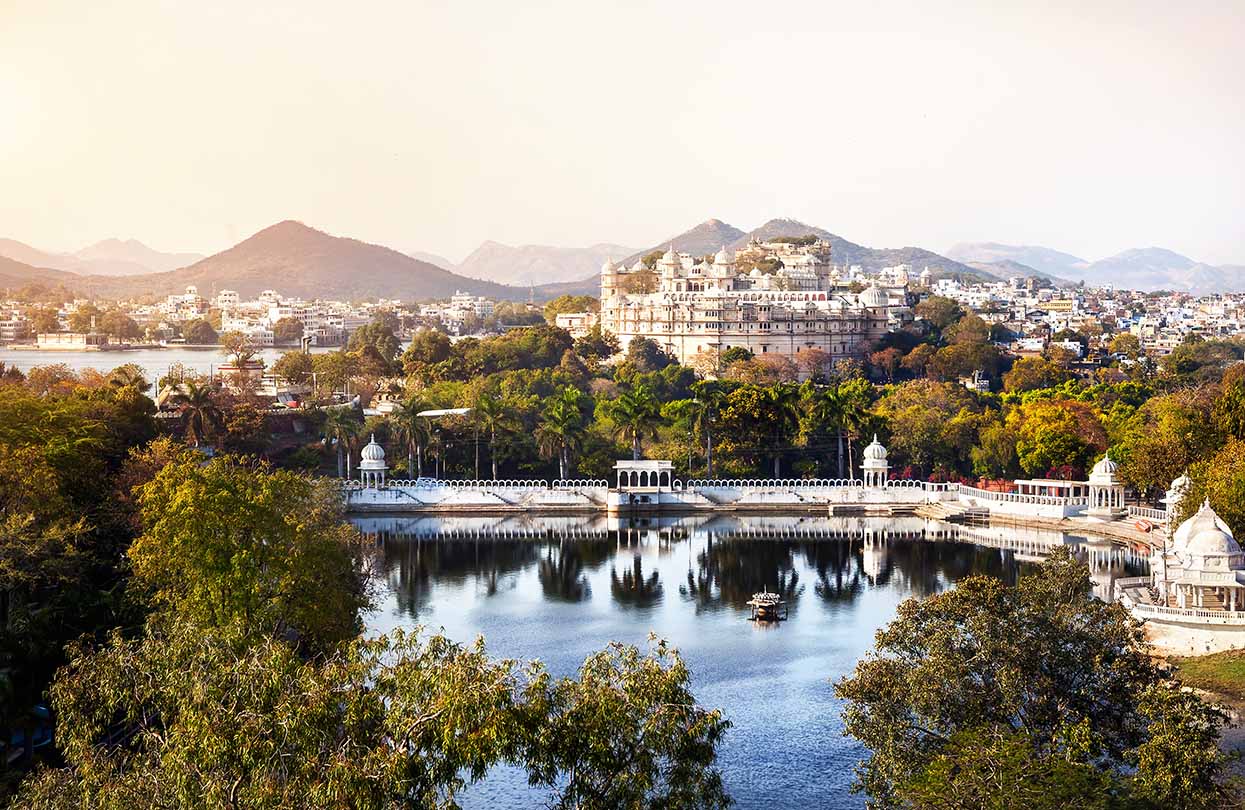
India’s Most Intimate Valentine: Udaipur. I always tell friends there are two kinds of Valentine’s escapes: the ones that try too hard, and the ones that simply change the air around you. Udaipur belongs firmly to the second. Somewhere between the hush of Lake Pichola and the Aravalli light that gilds every dome, the city edits out noise and leaves you with the person you came for. This city is blissfully doable—a short international hop into Delhi or Mumbai, then a swift domestic flight to Udaipur (UDR). By late afternoon, you’re on a private launch skimming toward a white palace that seems to float.
I checked into the Taj Lake Palace because sometimes romance needs a setting that refuses to argue. The approach is half the experience: a polished wooden boat, water slipping past like silk, the palace rising in perfect symmetry. Inside, a butler placed rosewater on my wrists and the city suddenly became a private world. Suites stare directly onto the lake—jharokha windows framing gulls and ghats, candlelight throwing patterns across carved marble. If you prefer shore with sweep, The Leela Palace and The Oberoi Udaivilas deliver their own theatre: colonnades, courtyards, and gardens stitched to the waterline. Choose lake-facing rooms; the night reflections matter.
Valentine’s is less volume and more precision. We started with a guided sunset walk through the City Palace complex, timed so the heat had softened and the courtyards were blooming with amber light. Our historian was a gentle conspirator, pointing out a fresco I might have missed, a corridor where the sound changes, the exact balcony that catches the last rim of sun. If you love craft as much as I do, ask your concierge to arrange a private hour with a miniature painter in the old city—a quiet studio, squirrel-hair brushes, gold leaf, and the delicious feeling of learning something together. Your keepsake becomes a shared piece of work, not just a purchase.
Read More: Discover Jodhpur, India’s Stunning Blue City
Dinner should feel inevitable, not orchestrated. On the island, a marble courtyard turned into a dining room—low lanterns, brass thalis, a breeze that politely cooled the candle flames without stealing them. The menu moved through Rajasthan without cliché: smoked laal maas for depth, millet rotis glossed with ghee, and a delicate saffron kheer that arrived just as the lake went mirror-still. If you’re on the shore, book a boat across to Jagmandir for a late seating and take the return ride in near-silence; the water carries sound differently at night, and the palaces float like they’ve been repainted.
Udaipur Is the Valentine You Don’t Have to Explain
The next morning was for being unhurried. We booked a couples’ ritual that blended classic Ayurveda with Rajasthani sense: warm oil abhyanga to soften the travel from your muscles, a gentle kansa wand facial to lift city from your skin, and an herbal soak perfumed with Himalayan botanicals—jatamansi, rose, a whisper of cardamom. There’s a reason I advocate for morning spa time: you emerge newly calibrated, and the day feels like a gift you open slowly.
Udaipur is merciful with choices that don’t break the spell. We asked for a private boat before the evening waves of sightseers—an hour of skimming past Gangaur Ghat, tracing the curve of Ambrai, peeking at tiny temples that catch the light first. If you like a bit of height with your romance, time a drive to Sajjangarh (Monsoon Palace) for twilight. Go early; the magic happens ten minutes before you think it will, and you’ll want the last quiet bench. Another favorite is Badi Lake, less crowded, more contemplative—take a thermos of masala chai and watch the hills shift from ochre to ink.
Food in Udaipur is honest comfort executed with care. For lunch, I love simple thali rooms where the service is faster than your appetite. For dinner on land, Ambrai gives you a storyboard view of the lake; ask for a table at the edge and order simply—grilled fish, seasonal vegetables, rotis puffed to the size of a child’s hat. If you want a private finale, many palaces can stage a candlelit gazebo within their gardens; the best ones keep the menu tight and the service invisible.
A word to the culturally curious: Udaipur’s ateliers are generous if you approach with respect. Pichwai painters in tiny rooms will talk pigment if you listen; silver smiths still shape by hand in workshops that smell faintly of ash and polish; block printers keep indigo bubbling in courtyard vats. Buy directly when you can. Choose one significant piece—an embroidered pichwai fragment, a hand-beaten kada, a length of mulmul printed the old way—and have it wrapped for the flight home. It’s romantic to build a home together with objects that carry stories.
Read More: 11 Reasons To Visit Sikkim, India’s Alps
The city also holds space for modern gestures. I booked a private rooftop music hour—two classical musicians, a tanpura drone soft as an exhale, ragas bending into dusk. There’s no audience to impress; you sit with your person and let sound do what it’s always done best. If that feels too still, switch to a guided photo session close to golden hour. A good local photographer will thread you through alleys washed in bougainvillea, line you up against a lime-plaster wall, and catch the exact moment the lake turns to hammered gold. The images feel like you—present, unposed, and exactly within the city’s measure.

Insider’s Tip
Insider tips that saved us from the trivial: book the last pre-sunset boat slot rather than the “sunset cruise” (fewer people, better light); avoid midday City Palace crush by pairing it with breakfast and an early entrance; keep shoulders covered for temples—linen steals keep it elegant; and ask your hotel to hold a table for tea just after your return from anywhere. Those fifteen minutes with saffron chai and something sweet become the daily hinge where conversation deepens.
If you’re weaving this into a longer itinerary, Udaipur pairs beautifully with a quick Jaipur hop (for jewelry and block print), or with a flight down to Goa for sea-air after stone and water. From India’s metros, it’s the easiest kind of luxury: one domestic flight, one boat, and suddenly your world is marble, mirror, flame.
How to book it beautifully? Three moves. First, pick your night—full moon is luminous on water, but any clear evening will do—and secure a lake-facing suite well ahead; the rooms you want are few and they hold memory. Second, choose one anchor experience per day: a palace walk with a historian, a couples’ ritual at the spa, a boat drift, a music hour. Don’t stack. Udaipur works because it refuses rush. Third, let the city feed you simply at least once—dal baati churma eaten with fingers, a street-side kachori on a clean leaf, fresh jalebi at 5 pm when the oil is new. It’s astonishing how romantic simplicity becomes when you stop hurrying.
Read More: Nubra Valley: An Adventure Through India’s Himalayan Hideaway
On our last night we sat at the edge of the terrace and counted lamps across the water. A lone oar made small sounds, somewhere a temple bell braided with a flute, and the palace cast its reflection like a signed promise. This is what I mean by air that changes around you: the world narrows to person, light, and the knowledge that good love is rarely loud. If you’ve been searching for a Valentine’s escape that feels regal without pretence—close enough to be easy, far enough to feel elsewhere—come to Udaipur. Let the palaces do their quiet work. And carry the lake home, the way all good journeys allow you to carry something home—an object, a new pace, a better way of listening to each other. ◼
Subscribe to the latest edition now by clicking here.
© This article was first published online in Jan 2026 – World Travel Magazine.