

|
Listen To Article
|
I arrived in Ras Al Khaimah just before dusk, when the dunes turn the colour of steeped saffron and the air cools enough to taste. Twenty minutes from town, the Al Wadi Nature Reserve opened like a private stage: rippling sand, ghostly ghaf trees, and, if you’re lucky, the delicate footprints of last night’s visitors—gazelle, fox, something small and quick that vanished before dawn. This is where the clichéd desert “safari” gets rewritten. Skip the convoy dune bashing and souvenir queues. The luxury here is silence, precision, and encounters measured in presence, not decibels.
My first evening set the tone at Sonara Camp Al Wadi. A private 4×4 slid through the reserve, headlights low, and we crested a ridge as the sun dissolved behind it. Aperitifs appeared as if conjured—citrus and mint, a tray of warm canapés—and the dunes shifted through apricot to bronze. Gazelles sketched pale arcs in the distance; after dark, an Arabian red fox padded into the glow, curious and utterly unhurried. Dinner unfolded beneath a sky unpunctured by city light: yogurt-marinated chicken taouk, jewel-bright salads, mignardises that arrived like miniature constellations. Between courses, a falcon swept the air in a silent crescent; the handler’s hand signals read like choreography. It felt less like a show and more like an old language spoken fluently.

Al Wadi Desert Nature Reserve, image by RAKTDA
Mornings here belong to the soft-footed. I set an alarm for that blue-grey hour when the sand still holds night’s cool and took a private wildlife drive (5:30–8:30 a.m.). The reserve is most articulate then: Arabian oryx standing immaculate against the dunes, sand and mountain gazelles browsing at the edges of the ghaf, a desert hare tracing a wavering script across the flats. With a naturalist in the front seat, I learned to scan properly—shadow lines for movement, shrub bases for ears—and to let the vehicle idle rather than intrude. If your party includes young wildlife lovers, ask to carry a small spotlight on a guided night drive: the beam often picks out jerboas, gerbils, and, occasionally, the lantern eyes of a Pharaoh eagle-owl.
Later that day came something I’ll file under “essential Emirates”: a private falconry lesson. In a low Bedouin-inspired majlis, the falconer placed a leather glove on my left hand and a heartbeat on my right—because that’s what a falcon feels like, contained velocity. We worked through stance, lure technique, and flight commands; then the hood came off and everything narrowed to sound and air. When the bird returned to the fist, talons soft as hands, the handler told stories about lineage, desert routes, and the way falconry braided survival with status long before it became performance. It was intimate, exacting, and deeply respectful—a luxury because of the attention, not the optics.

Falconer Holding a Falcon, image by Darren Baker, shutterstock
If you’re tempted by the idea of sleeping inside the desert’s quiet, Ras Al Khaimah rewards it. One night I opted for glamping at Bassata Desert Camp; another time, a beach-meets-desert hybrid at Longbeach Campground. Either way, a private tent layered with textiles, a fire pit, and the kind of darkness that invites the Milky Way to reappear. After dinner, we tried a gentle spotlight walk with a guide—foxes are common, owls possible, hyena and wolf firmly in the realm of serendipity—and then lay back for a guided stargazing session. High-powered telescopes brought Jupiter’s bands into view; blankets, spiced tea, and a laser pointer stitched myth into science. If you’re curious about astrophotography, request a mini-clinic; the desert is generous to patient lenses.
Another morning was reserved for a conservation-led wildlife experience: hand-feeding Arabian oryx and gazelles inside the reserve with a naturalist who spoke about browse, water strategy, and why this landscape functions like a finely tuned instrument. The point wasn’t novelty; it was perspective. To stand close to an oryx—those perfect lines, those museum-grade horns—and recognise how precarious and carefully stewarded its survival has been, shifts the day’s scale. We drove on, quietly, and it felt appropriate to leave nothing but tyre sigh.

Arabian Oryx on a dune, image by Wirestock Creators, shutterstock
Not every hour needs wheels. On a breezy afternoon I traded 4×4 for two wheels and joined a private bird-watching cycle. The guide fitted a lightweight bike and handed over binoculars and a compact scope, then led me along a low-impact route past stands of tamarisk and open flats favoured by hoopoes and rollers. The desert’s palette sharpened when seen at pedalling speed; we stopped for a picnic under a lone ghaf and identified silhouettes as the light tilted—steppe buzzard, maybe; certainly a kestrel riding a thermal. For equestrians (or beginners who want the grace without the gallop), the reserve’s stables offer private rides on Arabian horses. Arena refreshers, then out to the paddocks and sands in the soft light, with ponies available for children and the promise of tea and dates in the shade when you return.
Of course, you can wrap a single evening in velvet if time is tight. A tailored private safari with a gourmet camp dinner compresses the essence into six curated hours: pick-up in an air-conditioned 4×4, an unhurried drive that favours sightings over stunts, then a Bedouin-style camp where discretion is the dominant design. Expect custom henna, a quiet shisha corner with premium blends, a falcon photo moment (ask for the handler who prioritises bird welfare), and a serious grill line—lamb cutlets, marinated prawns, salads with new-mint brightness. Live performances can be scaled to your taste: a single oud, a whirling Tanoura, or simply the fire artist’s breath flaming briefly against the dark. The coffee—cardamom-scented, poured from a dallah—is small and strong, the traditional punctuation to a generously paced night.
If you’re building a fuller itinerary, fold in a late-afternoon 4×4 for golden hour photography (the dunes are at their most sculptural just before sunset), then reserve Sonara for dinner on one night and a quiet in-villa feast on another if you’re staying inside the reserve—there are properties whose suites spill onto private decks where you can eat under a dome of stars with nothing but the occasional camel silhouette crossing the horizon. Many camps and resorts can arrange sunrise yoga on a low ridge, spa rituals that borrow from regional botanicals, or even a sound bath in a candle-lit tent. In winter, the desert air carries just enough cool to make warmth feel earned; heated plunge pools and thick robes complete the scene.
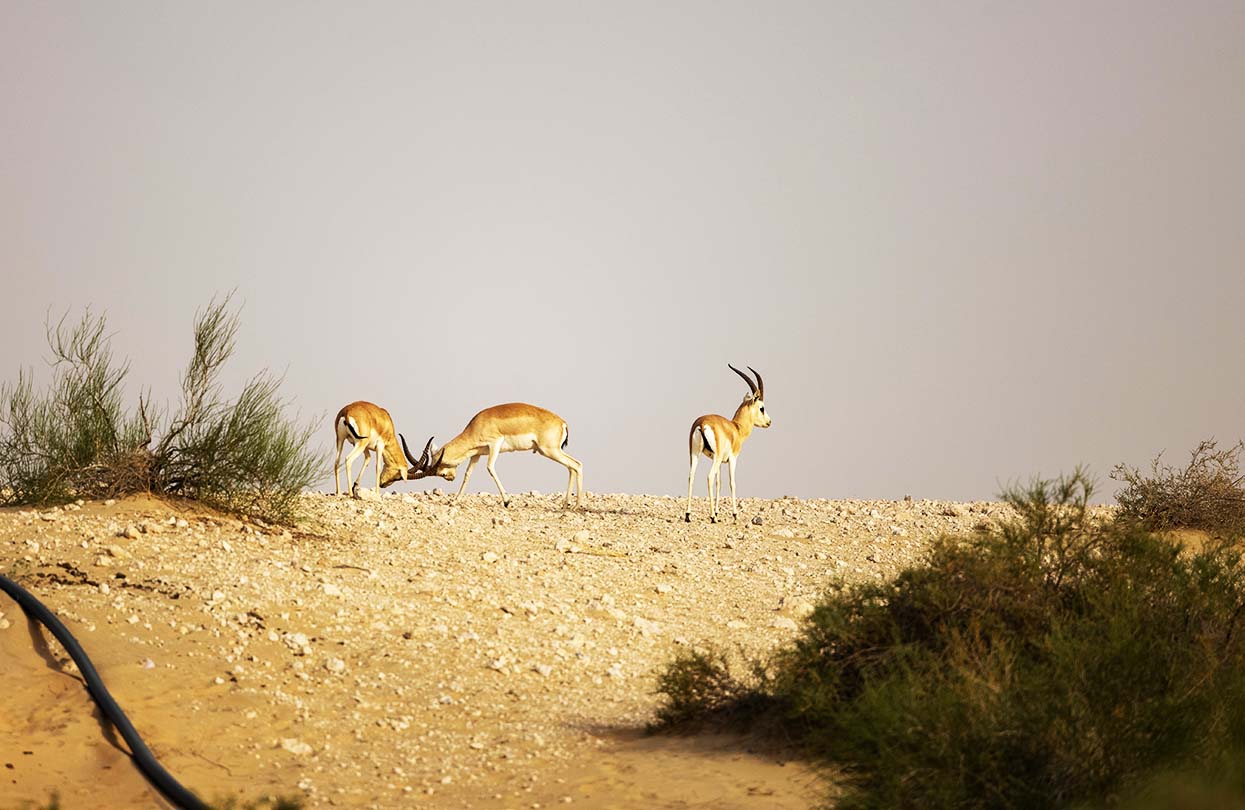
Arabian Sand Gazelle in natural habitat conservation area, image by Hyserb, shutterstock
A few notes from the field, learned the good way. Wildlife is most active in the bookends of day; book early-morning (5:30–8:30 a.m.) or late-afternoon (3:30 p.m. to sunset) drives for the highest chance of oryx, gazelles, and desert hare. Wear desert-sensible shoes (sand swallows heels), carry a light scarf for wind, and bring a soft-shell layer for night drives. If you’re keen on specific species—MacQueen’s bustard, lappet-faced vulture, goitered gazelle—tell your guide in advance; they’ll design routes that improve your odds without disturbing the rhythm of the reserve. And while sightings of striped hyena or Arabian wolf make folklore out of itineraries, they’re rare; the luxury is in accepting the desert’s terms.
Read More: Green Side Of The Desert
People sometimes ask me what makes a “luxury” desert safari different. It isn’t a higher dune or a louder engine. It’s the calibre of quiet, the knowledge in your guide’s pockets, and the way an evening gathers details that feel hand-placed: a lantern lit at the right moment, a telescope already aligned, mint chopped finer than habit. In Ras Al Khaimah, the desert supplies the architecture; you come for the edit. I left with sand in my shoes (inevitable), starlight in my camera roll (attempted), and a new understanding of how softly a wild place can teach you to listen. ◼
Subscribe to the latest edition now by clicking here.
© This article was first published online in Dec 2025 – World Travel Magazine.


