
|
Listen To Article
|
The granite comes first. Before the beaches, before the water, before anything the brochures would lead with, there are the boulders — vast, rounded, the colour of old pewter, tumbled at the edge of the sea as though a giant had set them down and walked away. You round a headland on La Digue and there they are, some taller than a house, worn smooth over a span of time the mind refuses to hold. These are among the oldest islands in any ocean, fragments of a continent that broke apart while the first complex life was still a rumour. Stand among them long enough and the usual travel vocabulary — stunning, breathtaking — falls away, because it was built for lesser things.
Then the water. I have seen a great deal of tropical sea, and I was not prepared. It arrives in bands: a clear shallow green over the sand, a turquoise further out, then a blue so saturated it looks retouched, a colour a photographer would be accused of inventing. On Anse Source d’Argent, where the granite wades into the shallows and the light breaks between the boulders, I stopped walking and simply stood. I have argued for years that beauty and comfort are different currencies. This was the first, undiluted.
I went in July, which anyone who knows the Seychelles will tell you is the season to go. The southeast trades were up, drying the air and clearing the sky, cutting the humidity to something a person can think in. The days were bright and breezy, the sea flatter on the leeward coasts, the evenings cool enough for a jacket you didn’t expect to pack. It is also, for anyone flying from India, a shorter journey than the destination’s reputation suggests — a few hours in the air, and you are somewhere that feels much further from everything.
The islands divide their labour. La Digue keeps a nineteenth-century pace: the taxis are bicycles, the heavy lifting is done by ox-cart, and the loudest sound most afternoons is a fruit bat crossing the canopy. Praslin holds the strangest thing in the archipelago — the Vallée de Mai, a valley of primeval palm forest so intact that the men who first described it thought they had found the original garden. It is dim and close and prehistoric, loud with birdsong, and it grows the coco de mer, a palm that produces the largest seed on earth, a thing so improbable it was once believed to grow on the sea floor. You walk through it and time behaves differently. Mahé, the main island, carries the ports and the markets and the ordinary life of the place, and reminds you that the Seychelles is a country, not a resort.
The seclusion, when you want it, is real, and it is the private islands that hold the high end of it. On North Island, a handful of villas sit on their own beaches and the staff outnumber the guests several times over; the point was never the thread count — it was that the beach was yours and the reef intact. Frégate Island Private runs to the same logic — one island, a few families at a time, and a conservation programme that has carried a nearly-lost bird back from the edge. Six Senses Zil Pasyon, spread across the boulders of Félicité, does the trick a little more openly, its villas folded between the same ancient granite that started this whole story. What they sell, underneath the service, is one commodity: space, silence, and the absence of anyone else.
View this post on Instagram
That absence is not an accident, and this is the part worth sitting with. The Seychelles has placed an enormous share of its land and a vast reach of its ocean under protection — reefs left to recover, turtles left to nest, whole islands handed back to the tortoises. On the conservation islands, the giant tortoises move through the day on their own terms, unbothered, older than anyone watching them; on Denis and Bird they cross the sand as though the beach were built for them, which, in a sense, it now is. This is where the real luxury lives. Not in more — more marble, more spectacle, more built — but in less. Less concrete. Less crowd. Less human hand on a landscape that took hundreds of millions of years to become itself.
I keep returning to that inversion, because it runs against everything the industry is built to sell. So much of what we call luxury is addition: another amenity, another wing, another superlative. The Seychelles offers the opposite and asks a higher price for it, and it is right to. Anyone can build. Almost no one, offered the chance, chooses restraint. The rarest thing a place can give you now is the sense that it has not been used up — and that is precisely what money struggles to buy, because it is usually money that does the using.
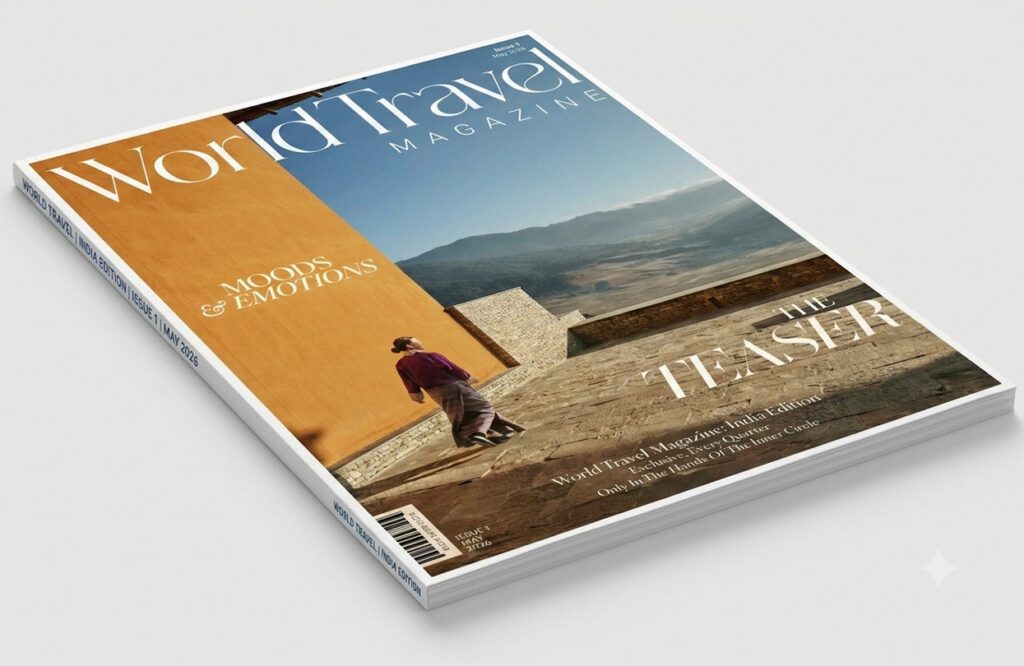
We started this magazine on the conviction that the World Travel Magazine reader is done being impressed and wants instead to be moved. The Seychelles moves you by leaving things alone.
On my last evening I sat on the granite as the sun went down. The stone had held the day’s heat and gave it back slowly. The water in front of me shifted from turquoise to a low, beaten gold, and then, further along the empty sand, a tortoise began to move — unhurried, ancient, entirely uninterested in me — crossing the beach the way it had crossed it for a century, in a place someone had the wisdom to leave exactly as it was. ◼
Subscribe to the latest edition now by clicking here.
© This article was first published online in July 2026 – World Travel Magazine.