
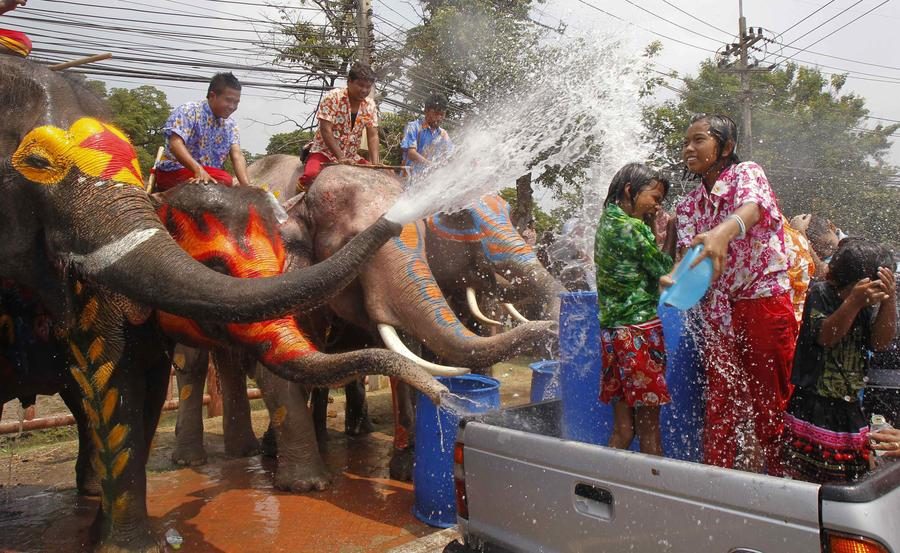
Celebrated across Thailand, the Songkran Water Festival heralds the new year with a country-wide water fight. It is a Thai national holiday and workers and students are given the days (and often a full week) off.
[vc_row][vc_column width=”1/4″][vc_separator color=”black” border_width=”10″][vc_custom_heading text=”Thailand”][vc_separator color=”black” border_width=”2″][vc_widget_sidebar sidebar_id=”sidebar-page”][/vc_column][vc_column width=”3/4″][vc_column_text]
Celebrated across Thailand, the Songkran Water Festival heralds the new year with a country-wide water fight. It is a Thai national holiday and workers and students are given the days (and often a full week) off. In its early years, the date of the festival varied because it was based on astrological calculations (the date the sun transits the constellation Aries), but now the date is fixed on April 13th-15th every year. The holiday is also celebrated in other Asian countries like Cambodia and Laos, but Thailand’s festivities are known to be the most exciting.
Songkran was originally a time to visit family and pay respects to elders, and to clean away the old year and bring in a fresh one. Many Thais washed away the old year by literally washing their homes and any Buddhas or Buddha images around the house. They would collect the water that ran over the Buddahs and pour it onto the shoulders of family for good luck. This tradition evolved to include throwing water on random strangers to help relieve the intense April heat.
Eventually the original purpose of the holiday became secondary to the national water fight that is so loved by Thais and foreigners today. People grab whatever they can get their hands on– buckets, water balloons, water guns, a hose– and douse each other with water. Sometimes chalk or menthol (the latter causes a cooling sensation) is mixed into the water to create a paste which people smear on each other’s faces for good fortune.
The holiday now draws a huge number of international tourists who are eager to join in the water battle. Popular tourists destinations (like Phuket) are some of the most exciting places to be during Songkran. Chang Mia hosts one of the biggest Songkran celebrations, with a festival of performances, street food, and a procession of an image of Buddha.
Those who celebrate the holiday more traditionally may scent the water with herbs and sprinkle it on their elders. Many people still visit temples to offer food and alms to Buddhist monks.
Traditional Thais, especially the elders, sometimes complain that the holiday has lost its original meaning and call for more stringent control of the holiday, especially traffic control, because there have been many accidents caused by people throwing water in the faces of riding motorcyclists.
Some traditionalist also complain of the lack of dress code; some clothing inevitably becomes see-through when doused in water. It is recommended that festival attendees dress as if they were going to the beach: light fabrics with a bathing suit underneath.
If you plan to visit Thailand, the days of Songkran are a great time to go to get plenty of exposure to Thai traditions. But rest assured, you will get wet.
Subscribe to the latest edition now by clicking here.
If you would like to comment on this story or anything else you have seen on World Travel Magazine, head over to our Facebook page or message us on Twitter.
And if you liked this story, subscribe to our bi-monthly World Travel Magazine, a handpicked selection of editorial features and stories from Global Destinations, Inspire Me, Insider, Style File, Wellness & Travel, City Travel, Suite Life, At Leisure, Short Breaks and much more.
[/vc_column_text][/vc_column][/vc_row]