|
Listen To Article
|
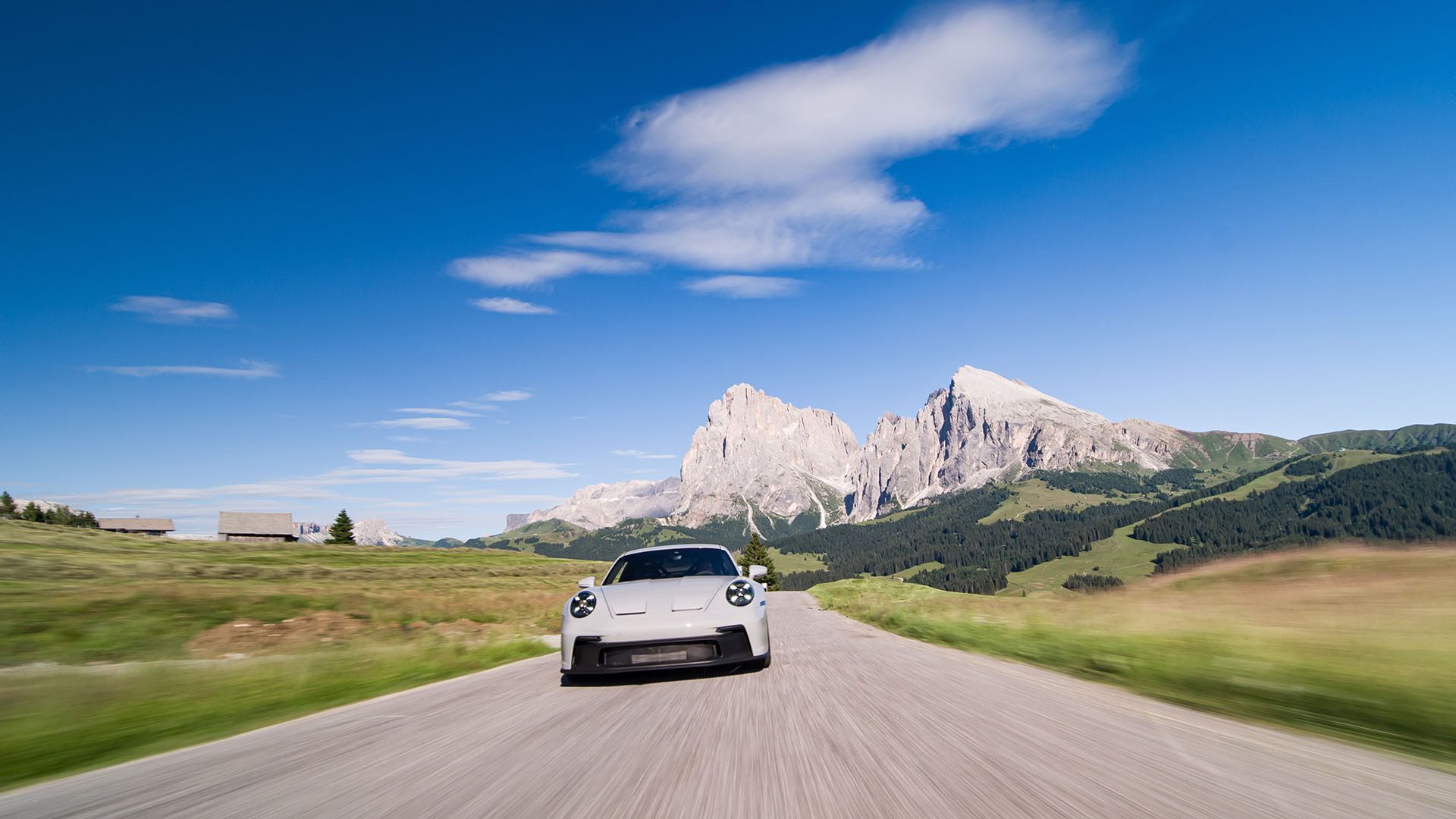
The man at the rental desk in Bolzano handed me the key to a Porsche 911 Cabriolet the colour of a swimming pool and said, “Drive it like you rented it, not like you own it.” I didn’t know what that meant. Meera, my wife, translated at once. “It means slowly,” she said, and was in the passenger seat before I could argue.
This was July, which is the whole point. The great Dolomite passes are open perhaps four months a year. The rest of the time they belong to the snow. In summer they belong to whoever turns up, and mostly that means cyclists, who climb the Passo Pordoi in numbers you normally see at pilgrimages, in Lycra the colours of boiled sweets, every one of them thinner than my ambitions.
We had a plan: the Sella Ronda, a loop of four passes around a single massif, each named like a pudding. Gardena. Pordoi. Campolongo. Sella. And lunches. I had booked the lunches months earlier with the seriousness other men bring to proposals.
“You’re navigating,” I said, starting up the Passo Gardena.
“I know.”
“So which way does it bend?”
She studied the map with the confidence of a woman holding it upside down. “Left.”
The road bent right, hard, and kept bending, a hairpin folding back on itself like a letter someone had thought better of. The pale walls of the Sella group rose ahead of us, colourless and enormous, the rock the Ladin people here call the Pale Mountains because at certain hours it holds no colour at all, only light. I forgot, briefly, to be smug.
“You missed the viewpoint,” Meera said.
“I was looking at the actual view.”
“There was a sign. It had a little camera on it. That’s the official one.”
The 911 did not care about official viewpoints. With the top down, the engine behind us clearing its throat on every straight, the car did the thing good cars do, which is make you feel briefly and dangerously competent. Then a cow walked into the road. Then four more. An entire Alpine congregation, unbothered, chewing, regarding the Porsche with the flat contempt only livestock can manage. We stopped. We waited. A farmer touched his cap. Meera rolled down her window and said something in the three words of German she owns, and the man laughed, and I understood that on this trip I was, at best, the third most charming presence in the car.
Here is the part nobody tells you about South Tyrol. You come for the driving and you stay for the food, because this small province, half Italian and half Austrian and entirely itself, has one of the highest concentrations of great restaurants on earth. We came down off the Gardena to St. Hubertus, Norbert Niederkofler’s Atelier Moessmer in Brunico, where the philosophy is printed on everything and lived in every dish: Cook the Mountain. Nothing arrives from far away. No citrus, no pepper from other latitudes. Only what the valley gives, transformed until a turnip tastes like an argument you lose gladly. Meera had the trout. She did not offer me any. This told me it was very good.
View this post on Instagram
The next day we took a cable car up to AlpiNN, Niederkofler’s restaurant at 2,275 metres, where you eat behind a wall of glass with the Dolomites arranged outside like a rumour of heaven. A glass of Alto Adige white, a Kerner, cold and mineral and tasting faintly of the stone it grew on. Below us the passes we’d driven lay coiled and small. “You drove that this morning,” Meera said, pointing at a thread of road on the Pordoi. “Badly,” she added, but she was smiling, and she put her hand on mine, and the waiter pretended not to notice.
We drove the Stelvio because you cannot not drive the Stelvio. Forty-eight hairpins stacked up a mountainside like a staircase built by someone in a temper, each one numbered, counting down, so that even the road is keeping score of you. Meera counted them aloud. She was, for once, exactly right about which way each one bent, because there was only ever one way: up, and then back, and then up. Cyclists waved. We waved back. Somewhere around hairpin twenty a man in a rented Ferrari behind us grew impatient, and I let him past, and Meera said, “See, he rented it too,” which I have decided means she was proud of me.
And then the turn, the moment I’ve been circling. It was the last pass of the last evening, high on the Pordoi with the top down and the light going gold and then rose across the Pale Mountains, the rock catching fire the way it has for the people of this valley for a thousand years. We had been arguing, gently, about a wrong turn that had cost us forty minutes and, I maintained, was entirely the map’s fault. And then we simply stopped. Not because anyone won. Because the mountains asked us to.
We pulled over at the summit. I switched off the engine and the Porsche began to tick as it cooled, that small metal sound of a good machine resting. Below, the lights of a rifugio where they would, absurdly, serve us canederli and a wine list that shamed cities. The road was in my hands still, warm on the wheel. The peaks were in our eyes. Somewhere down there a plate was waiting that would taste of the exact mountain we’d just driven over.
Meera didn’t say anything. Neither did I. This, I thought, is the whole thing that World Travel Magazine keeps trying to tell you: the best journeys use every sense at once. We sat there until the gold went blue, two people and a cooling car, quiet at last, with the whole day still warm around us and the evening only just beginning. ◼
Subscribe to the latest edition now by clicking here.
© This article was first published online in Aug 2026 – World Travel Magazine.