
|
Listen To Article
|
The first sound is wrong, somehow. You expect drums or bells, something declaratory. What you get is a low frequency that arrives through the soles of your feet before it reaches your ears. The dungchen — the long copper telescope-horns of Tibetan Buddhism, sometimes three metres in length, balanced on the shoulders of two trainee monks — speaks first. It is the sound of a mountain clearing its throat.
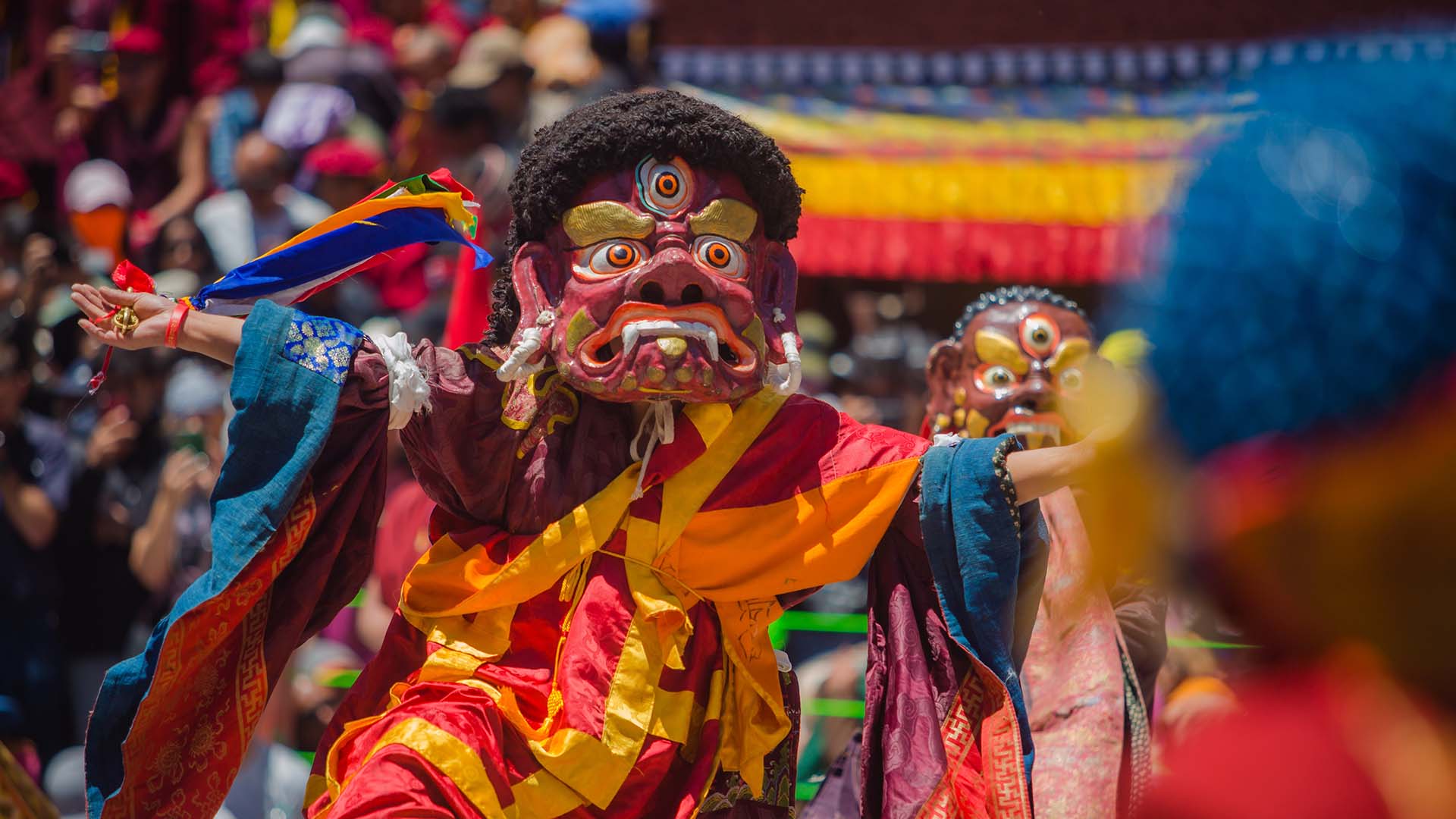
This is the moment before the masks come out. At Hemis Monastery in Ladakh on 24 June 2026, and again the next morning, and at half a dozen other courtyards across a vast belt of high country between then and the first snow, the air will fill with cymbals and shawms, and the masked dancers — the lamas of the cham — will enter to begin a ritual performed in something close to its current form for at least four hundred years.
The cham is not a folk dance. It is not, in any meaningful sense, a performance, even though it has an audience and a courtyard and choreography you could write down. The Drukpa Kagyu monks of Hemis describe it as visualisation made visible — a method by which protector deities are invoked, malign influences subdued in effigy, and the merit accrued shared with everyone present. The masks are consecrated objects. The dancers, beneath them, have spent weeks in prayer. That you are allowed to watch is almost a courtesy; the cham would happen whether you came or not.
What makes this summer worth tracking is the geography. Hemis is one node in a tradition that stretches across the entire Himalayan Buddhist world — Ladakh, Bhutan, the Nepalese Khumbu, Sikkim, parts of Tibet, Mongolia — and midsummer is when the courtyards open. On 24 and 25 June, Hemis honours Guru Padmasambhava, the 8th-century tantric master credited with carrying Vajrayana Buddhism across the mountains. Every twelfth year, on the cycle of the Tibetan Monkey, the monastery unfurls its giant Padmasambhava thangka — a two-storey appliqué scroll embroidered with pearls and gold. 2026 is not one of those years. The next unveiling is expected in 2028. The Drukpa Kagyu calendar keeps its own time.
View this post on Instagram
By September the same tradition has crossed the range. The Thimphu Tshechu, Bhutan’s largest, runs from 21 to 23 September — three days of cham in the courtyard of Tashichho Dzong, with the king often in the front row. By late October the masks have moved to Tengboche Monastery at 3,867 metres in Nepal’s Khumbu, where the Nyingma Sherpa community performs Mani Rimdu over the full moon of the ninth Tibetan month (26–28 October in 2026). And then Mongolia, where the tradition very nearly died. In the 1930s, Stalinist purges destroyed nearly every monastery in the country and killed an estimated seventeen thousand monks. Masks were burned. The dance — known there as Tsam — survived in fragments and has been rebuilt across three decades. Last summer at Khui Doloon Khudag outside Ulaanbaatar, more than a hundred dancers performed the Khüree Tsam in front of a public that, two generations earlier, had been forbidden to remember it.
“The mask is not a costume,” Dorji, a monk in his early thirties at a lhakhang outside Paro, told me last spring while sorting brocade in a back room. “The mask is the deity. When I put it on, the lama who trained me must hand it to me, and we both bow first. After, I don’t remember dancing. People say I danced well. I have to trust them.” This is the texture missing from most accounts. The cham is interior work that happens to be visible.
Witnessing it well is, in the end, an exercise in accepting that the calendar is not yours. The Hemis festival begins when it begins; the masks come out when the chant has reached a particular line. The argument World Travel Magazine has been making, in pieces like this one, is that the surrender to that schedule is itself the luxury — and that the lodges quietly built within driving distance of the relevant courtyards are the instrument that makes it possible. In Bhutan, &Beyond Punakha River Lodge, Six Senses Bhutan and Pemako Punakha have made it routine to be at the dzong gate at dawn and back in a hot bath by lunch; the Aman properties across the kingdom remain a benchmark for the form. In Ladakh, Shakti Himalaya’s village-house circuit and the high-end camps that materialise for Hemis manage the same logistics on far harder ground.
What none of these places sell, because it isn’t theirs to sell, is the dance itself. You arrive. You sit on the stone. You wait. The horn sounds, and then you understand why you came.
The cham ends not with a flourish but with a kind of disassembly. The dancers exit. The drums slow. Inside the monastery, in a side chamber, the masks come off one by one, and the men beneath them — many of them young, twenty-two, twenty-five, with the slightly stunned look of someone returning from a long swim — drink butter tea and roll their shoulders and laugh at each other’s hair. The masks go back to their hooks. The deity goes back to wherever the deity lives between summers. The man who carried it walks out into the courtyard with a phone in his hand, looking for his nephew.
That is the moment. The extraordinary is allowed to become ordinary again. The whole tradition rests on this: that the divine arrives, is danced, is released. The traveller who came for spectacle leaves with something quieter — an ordinary monk, breathing hard, becoming himself again under the late afternoon sun of a Himalayan summer. ◼
Subscribe to the latest edition now by clicking here.
© This article was first published online in June 2026 – World Travel Magazine.