|
Listen To Article
|
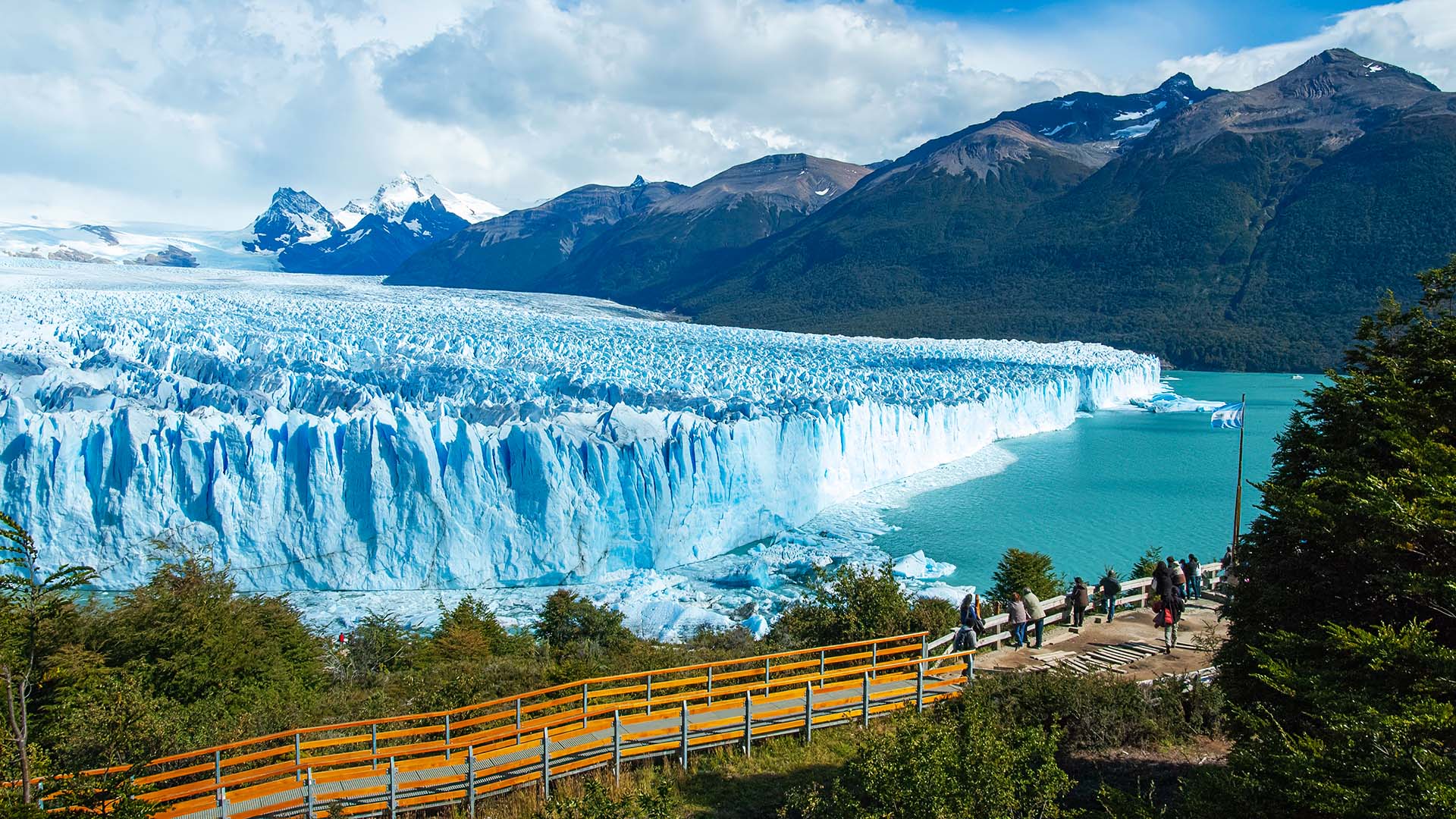
The Glacier Calves While the Lamb Turns. The first sound is not the crack. It’s a breath, a low, structural exhale from somewhere deep inside the ice, the sound of a thing deciding. Then comes the crack, and then a slab the height of a seven-storey building shears off the face of the Perito Moreno glacier and drops into Lago Argentino, and the milky water throws it back up as a wave. In July, in the thin winter light, there are perhaps nine of us on the boardwalks to watch it. In January there would be nine hundred.
“People wait all day for that,” says Mauro Antinao, who has guided on this ice for eleven winters and has stopped counting the calvings. “And the glacier doesn’t care. It has been doing this since before Argentina was a word.” He says it without romance, the way a man talks about weather he lives inside of.
The name on the map is a clue to how this country reads itself. Perito Moreno, the perito, the expert, was Francisco Moreno, the surveyor who walked this frontier in the 1890s to fix the line between Argentina and Chile, and who was paid partly in land he later gave away. Patagonia was mapped by a cartographer, and it has never stopped being a place obsessed with where one thing ends and another begins. Ice and rock. Argentina and Chile. Wild and warm. Stand on the boardwalk long enough and you understand the through-line: this is a landscape organised entirely around edges.
The glacier is one of the few on earth advancing rather than retreating, which is why you can watch it work. It presses forward against the Magallanes peninsula until the ice dams the lake, the water rises behind it, and every few years the pressure blows an arch through the front in a rupture that draws the whole country to its televisions. It is geology performed as theatre. And in winter, with the tour boats thinned to almost nothing and the crowds gone home, the theatre plays to an empty house, which is the only way to hear that first breath before the crack.
An hour’s drive from all that blue, the second half of the map is already lit.
At Nibepo Aike, a working estancia on the shore of Lago Roca, the fire is started before the guests are awake. The lodge takes its name from three daughters, Nini, Bebé and Porota, of the Croatian immigrant who built the place out of sheep and stubbornness a century ago, when wool was the money that made this frontier worth settling. The sheep are still here. So is the fire.
View this post on Instagram
“An asado is not cooking. Cooking is what you do on a stove,” says Ramón, the gaucho who has the lamb. He has splayed a whole cordero on an iron cross, the asador, and driven it into the ground at an angle beside a bed of coals, ribs to the heat. It will turn there for the better part of a day. “The fire does the work. I only pay attention.” This is the discipline hiding inside what looks like a rustic pleasure: three or four hours of doing almost nothing, correctly. The gaucho’s genius is patience dressed as ease.
To eat here is to read the country’s argument about itself directly off the plate. Argentina’s relationship to meat and fire is not a cuisine so much as a grammar, the estancia, the open flame, the communal table, the bottle passed hand to hand. The Malbec that comes with the lamb is from Mendoza, a thousand kilometres north, but the newer bottles increasingly are not: Patagonian wine is climbing south into the cold, thin-skinned Pinot Noir and sharp-edged whites from Río Negro and Neuquén that taste of the wind they grew up in. The land here has always been treated as inseparable from what it feeds you. The gaucho did not invent the asado to charm anyone. He invented it because he was alone on an enormous plain with an animal and a fire, and hospitality was how you survived the distance between one estancia and the next.
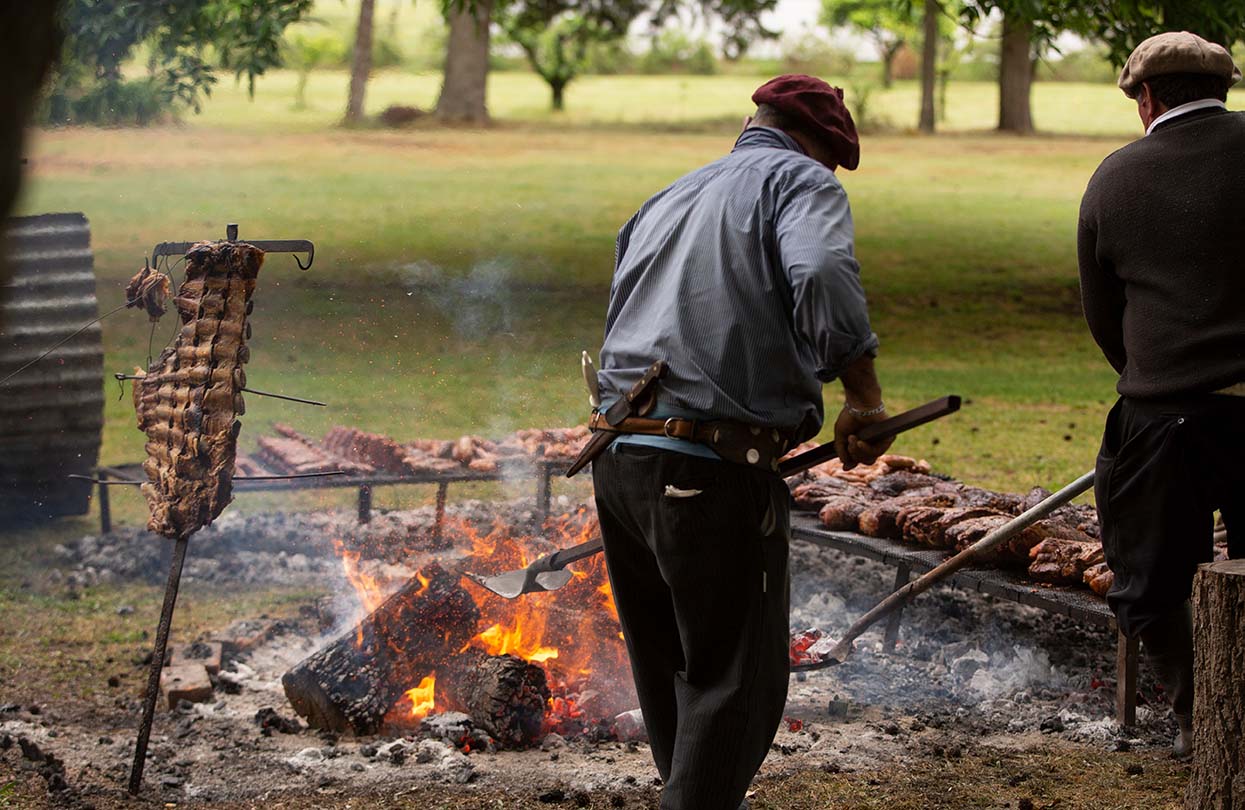
A gaucho getting dinner started on a asado, Image by Maria Elisa Rol, Shutterstock
There is a version of this place sold as emptiness and silence, and Eolo, the elegant lodge on the steppe outside El Calafate, named for the god of wind, trades beautifully on exactly that. But the steppe is not empty. It is worked. Every horizon has a fence line and a flock and someone whose grandfather is buried under the wind.
And to the north stands the country’s other cathedral. El Chaltén, the trekking village at the foot of Cerro Fitz Roy, empties out in winter until it is mostly closed doors and one open café, and the peak, the granite spire the Tehuelche called Chaltén, the smoking mountain, for the cloud that always hangs off it, stands over the whole valley in fresh snow with almost no one beneath it. In summer the trails to its base are a procession. In July they are yours.
By the time the light goes, back at the estancia, the cordero has been turning for hours and the coals have burned down to the colour of dawn. Ramón lifts the cross out of the ground and lays the lamb on a board, and it comes apart without a knife. Outside the window the cold is total and the dark is wild and somewhere out there the glacier is still breathing and cracking in the black. Inside there is fire, and lamb, and a Río Negro red going around the table a second time. That is the whole cartography of Argentine Patagonia in a single evening, the ice and the fire, an hour and a world apart, finally sitting down together. This is the case World Travel Magazine will keep making: that the coldest, wildest edge of the map holds the warmest table on earth. ◼
Subscribe to the latest edition now by clicking here.
© This article was first published online in Aug 2026 – World Travel Magazine.