
|
Listen To Article
|
There is a stretch of Australian coastline where the tide moves so hard and so fast that the sea pours through two narrow gorges like water forced through a keyhole — a waterfall that runs sideways, twice a day, and reverses when the tide turns. The Horizontal Falls. Most people know them from a photograph and assume they’ve understood them. They haven’t. You feel them in your chest from the tender, and again from the helicopter, and you spend the rest of the trip recalibrating what a coastline is allowed to do.
This is the Kimberley — Australia’s vast northwest, a wilderness roughly the size of a mid-sized European country, most of it without a road of any kind. And the reason we are talking about it now, in July, is that July is the answer. The wet season shuts this country down completely; the rivers rise, the tracks dissolve, the air becomes unbreathable. Then the dry arrives, the land hardens, the light goes clean and gold, and for a handful of weeks the whole place becomes not just navigable but comfortable. That window is the entire game. A family I know who plan nothing without their advisor signing off first missed it by three weeks one year and simply didn’t go — waited a full twelve months rather than do it wrong.
Here is how the people who do it right, do it.
The ship. The trophy Kimberley experience is the expedition cruise, and it is worth being precise about which one. True North is the local operator that everyone else quietly measures themselves against — an Australian ship, shallow enough to nose into places the bigger vessels can only photograph from the horizon, carrying its own helicopter on the back deck. Ponant’s Le Lapérouse brings the French hand — the design, the table, a lecture programme — to the same coast. Seabourn runs its expedition ship through here too, for those who want the wider ship and the larger world. The distinction that matters: the smaller and more purpose-built the vessel, the closer you get, and closeness is the whole point on this coast.
What you’re actually going to see: King George Falls, twin ribbons dropping the height of a skyscraper into a gorge you approach by tender until the spray is on your face (ask whether the captain will nose the bow into the base — the good ones do, when the swell allows). Montgomery Reef, which does not sit in the sea so much as rise out of it — as the tide drops, an entire reef surfaces, streaming water off its edges in a hundred temporary waterfalls, turtles and rays stranded in the shallows. And the rock art, which is the reason to come and the thing no one prepares you for adequately. The Gwion Gwion figures and the great Wandjina — some of the oldest continuous artistic tradition on earth, tens of thousands of years of it, on rock in country that has never stopped being cared for. These sites are visited on the terms of the Traditional Owners whose Country this is, and increasingly with Traditional Owner guides, which is not a courtesy but the only way the visit means anything. Choose operators who have those relationships in place; it’s the difference between looking at a wall and understanding it.
The lodges. For those who prefer the earth under them, the number of genuinely luxurious options is tiny, which is exactly why they’re worth knowing. El Questro Homestead sits on a working station of roughly a million acres, ten suites on a cliff edge above the Chamberlain Gorge — the kind of address that makes the words “private wilderness” mean something literal. Berkeley River Lodge, reachable only by light aircraft or by sea, has just reopened this season after a full rebuild, which makes it the freshest room in the region right now — a rare thing in a place where nothing is new. And Faraway Bay, the northernmost of them, a cluster of cabins on a headland with nothing between you and the Timor Sea. None of these you drive to. That is the point.
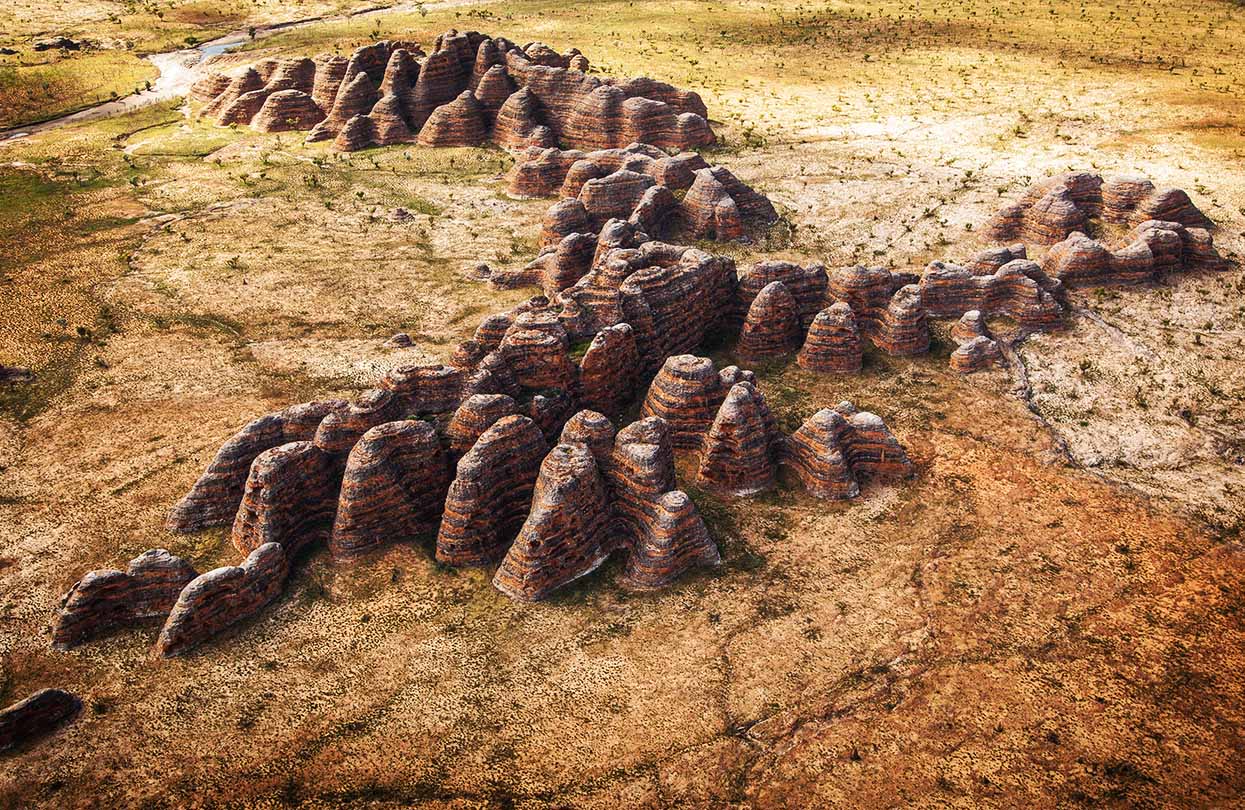
Bungle Bungles taken from dedicated a helicopter flight during the Wet season, Image by Philip Schubert, Shutterstock
The air. Whichever way you come, you fly. The single experience to protect on any itinerary is the helicopter over Purnululu — the Bungle Bungles, those improbable striped beehive domes that were essentially unknown to the wider world until the 1980s and can only be read from the air. Doors off, low and slow over the ranges, then set down for a gorge swim with no one else within fifty miles. Build the trip as helicopter-and-ship, or helicopter-and-lodge, and you have the high-end Kimberley in its truest form.
The intelligence. July and August sell out first, and they sell out early — the best cabins on the best departures are gone twelve to eighteen months ahead, and the marquee ships longer. If you are pointing this at a landmark birthday or an anniversary, and this is precisely the trip for one, start now for next year, not this one. Work through an advisor who holds allocation with True North or Ponant directly; the difference is which cabin and which departure, and on this coast that is the whole difference.
The World Travel Magazine view is that there are very few places left that are genuinely wild and that you can experience in genuine comfort, and fewer still where the window to do it is measured in weeks. The Kimberley is the greatest of them.
Picture the last of it: the helicopter tilting down toward a gorge no track reaches, the rotor-wash flattening the spinifex, and the red rock going redder as the sun drops — the pilot cutting the engine, and then nothing, no sound at all, the oldest country on earth holding perfectly still while you climb down into it. ◼
Subscribe to the latest edition now by clicking here.
© This article was first published online in July 2026 – World Travel Magazine.