
|
Listen To Article
|
Four hours’ flight from Delhi or Mumbai, three from Dubai or Doha, and you land at Heydar Aliyev International Airport in a city whose name, in old Persian, means roughly “wind-pounded.” Everything in Baku has been negotiating with that wind for a thousand years. The Caspian wind is the secret author of this skyline. Fire is the louder one.
To understand what Baku is doing now, read three buildings — and the spaces between them.
Twenty minutes north of the old city, the road opens onto Zaha Hadid Architects’ Heydar Aliyev Center, completed in 2012 after a competition won in 2007. From a distance it reads as a single landform caught between hill and cresting wave; up close, it stops being an object at all. There is no façade. The plaza you have been walking on lifts, folds, and becomes ceiling — then resolves into wall, then back into floor inside the lobby. Hadid’s office set itself a problem most architects only describe in conversation: eliminate the distinction between roof, wall, and ground.
The means are deliberately invisible. Two structural systems work in parallel — a reinforced-concrete structure and a space frame — and the vertical structural elements are absorbed into the envelope and curtain-wall system, so the interior reads as column-free. Where columns are unavoidable, they curl into curved “boot” forms that peel from the surface as if the building were exhaling. Outside, more than seventeen thousand custom-fabricated panels are joined by precisely-drawn seams — what the architects framed as the rhythm to the surface’s music. You only notice them because of how much they refuse to interrupt.
What this does to the body is the point. The eye cannot find a seam, cannot find a place to begin reading the building, so it lets you wander. The auditorium, the museum, the library — they are not rooms entered but undulations met. The freeform structure was engineered to address Baku’s high wind loads and the city’s seismic activity through the same continuous form. Hadid did not soften the wind. She enlisted it. The Heydar Aliyev Center is one of the genuine architectural arguments of the twenty-first century, and it is here.
View this post on Instagram
Half an hour south, behind a twelfth-century wall, is the city the Center departs from. Icherisheher, the Inner City, was inscribed on UNESCO’s World Heritage list in 2000, and within its perimeter the architectural logic inverts Hadid’s: enclosure rather than flow.
Begin at the Maiden Tower. Cylindrical, eight storeys, rising 29.5 metres above the south-east of Icherisheher, with a base diameter of 16.5 metres and walls five metres thick at the base tapering to between three and four metres at the top, it is the most studied unsolved building in the Caucasus. The Maiden Tower is a 12th-century monument, but archaeological analysis suggests the foundations and lower stories may date significantly earlier, possibly to the 4th–6th centuries CE, with some scholars arguing for pre-Islamic origins as old as the 7th–6th centuries BC. The purpose of the eastern projection — buttress, hiding place, equinox-marker — has never been conclusively identified. The interior is dim, narrow, cool. The walls are doing the work the wind would otherwise do to you. Climb the spiral stair and the city falls away in layers: stone roofs, then minarets, then the Caspian.
The Shirvanshahs’ Palace sits at the highest point of Icherisheher, built primarily under Ibrahim I and his son Khalilullah I across the fifteenth century. The complex contains the main palace, the Divankhana, the burial vaults, the shah’s mosque with a minaret, Seyid Yahya Bakuvi’s mausoleum, Murad’s gate, a reservoir and the remnants of a bathhouse — constructed primarily from local Baku limestone known as “badamdam,” prized for its almond-hued quality. The carved inscriptions over the doorways have eroded into something between writing and pattern. Read the Divankhana as a piece of geometry rather than a reception room and the logic emerges: octagonal pavilion, colonnaded ambulatory, domed roof — every interior decision pulling sound and heat upward and away, leaving the body cool at floor level. This is Silk Road architecture solving for forty-degree summers without machinery. The medieval caravanserais nearby, several reborn as restaurants and small hotels, run the same logic in miniature.
Stand at the Maiden Tower, look up, and the three flame-shaped towers above the city read as the same problem in a different vocabulary. HOK designed the Flame Towers; construction began in 2007, with completion in 2012. The towers reach heights of 182, 165, and 161 metres, and their curved facades are made of over 10,000 different glass panels, each cut to its own geometry. At night, the facades are turned into giant display screens by more than 10,000 high-power LED luminaires — flames, then the national flag, then water. Argue with the spectacle and you miss what it solves. The Caspian wind climbs the Highland Park ridge at speed, and that tapering, curved profile is what allows the towers to stand on the exposed hill at all.
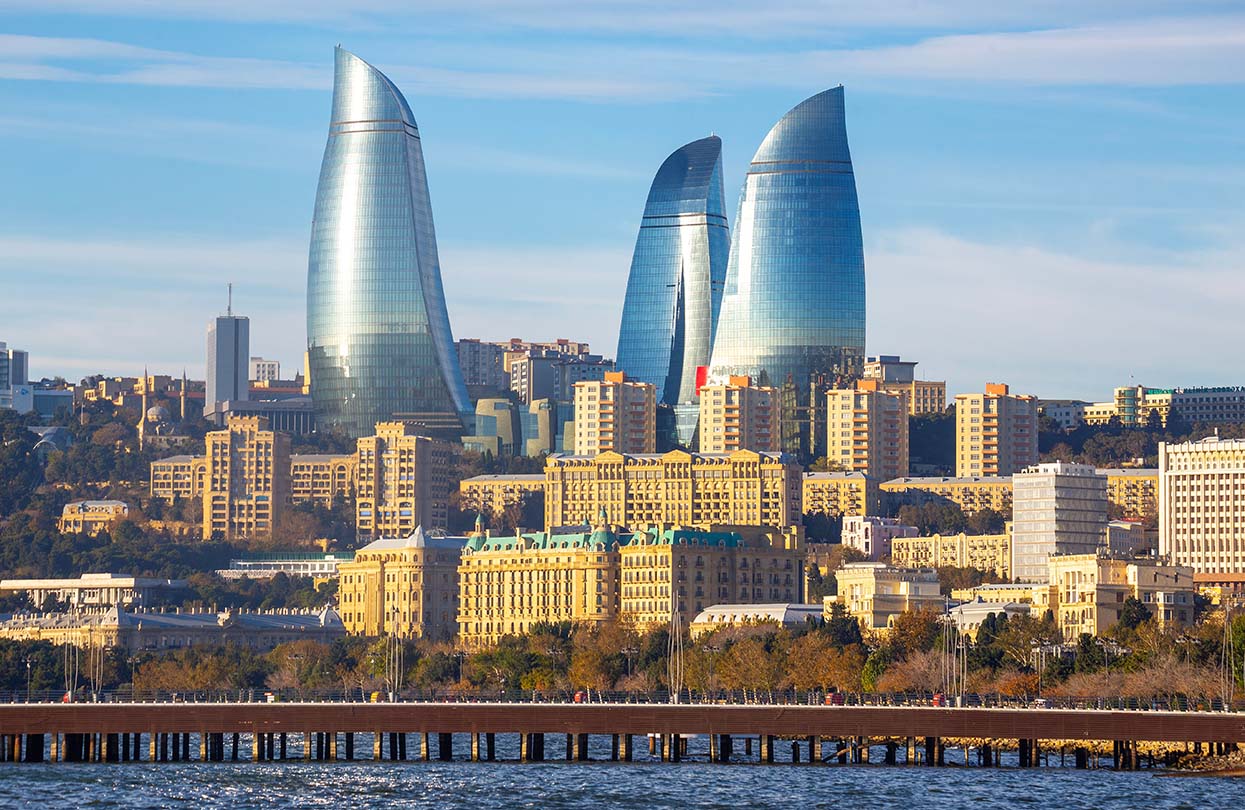
Flame Towers and view of Baku, Image by Lyokin, Shutterstock
The hospitality has caught up. The Fairmont hotel tower contains 250 rooms and 61 serviced apartments — the city laid out beneath your window in two centuries at once. Down on the boulevard, Four Seasons Hotel Baku, opened the same year, takes a different position. ReardonSmith Architects designed it as a classical building clad in cream-toned limestone from the local mountains, topped by a copper roof, drawing inspiration from the architecture of the late nineteenth-century French Riviera. It is the only building in this story pretending to be older than it is; it is also, deliberately, the most legible bridge between the medieval walls a hundred metres east and the flames flickering on the ridge above.
For readers of World Travel Magazine, the practical news is that all of this sits four hours’ flight from Delhi or Mumbai and three from Dubai or Doha, with daily non-stop service from each — Azerbaijan Airlines operates year-round flights to Mumbai, Delhi and Ahmedabad, flydubai connects Dubai year-round, and Qatar Airways flies Doha year-round. The older news is the argument the buildings are making to one another. Baku proves a city does not have to choose between its centuries. The best ones let them argue beautifully on the same skyline. ◼
Subscribe to the latest edition now by clicking here.
© This article was first published online in July 2026 – World Travel Magazine.