
|
Listen To Article
|
The Light and the Altitude
The plane drops between brown mountains. No trees on them. Then the runway at Leh, three thousand five hundred metres up.
You walk to the terminal and stop. The air does not fill your lungs the way you expect. You breathe again. It still doesn’t.
This is how Ladakh begins. Not with a view. With your own breath, suddenly audible.
The light is the next thing. It is enormous. It falls on bare rock and stays there.
The Indus valley is the colour of ash and bone. The river runs green through it. Above, the sky is a blue you squint against.
They tell you to rest the first day. You resist. Then you climb one flight of stairs and understand.
The altitude makes the decision for you. You slow down. You have no say in it.
At Chamba Camp Thiksey, the tents face the monastery across the fields. Canvas, a wood floor, a copper tub. Outside, the barley is green, and the apricot trees are heavy.
August is the season for this. The passes are open. The days are warm. The fields are at their greenest, just before the harvest.
You sit on the verandah. You had meant to do more. Instead you watch the light move down the mountain.
Morning comes early and cold. Six o’clock. No one else is awake.
The barley holds the light. A stream runs somewhere you cannot see. A dog barks once, far off, then stops.
You drink your tea slowly. There is no other speed available here.
By noon the sun is warm on your arms. The fields are worked by hand. A woman bends among the green rows and does not look up.
The mountains behind her are the colour of nothing. Dust, stone, old ash. Against them the barley is almost violent in its green.
An apricot drops into the grass. You hear it land.
This is the trade Ladakh makes. It takes your breath, a little. It takes your speed.
In return it gives you the morning. Long, slow, enormous. You have nowhere to be.
You had come for the monasteries. They can wait. Today the body learns a lesson the mind kept refusing.
Be still. There is enough air for stillness. There is not much for anything else.
View this post on Instagram
The Monasteries and the Silence
Thiksey stands on a hill above the valley. White and ochre, stacked toward the top. From the camp it looks like a small Potala.
You go up at dawn. The steps are steep. At this altitude you stop twice to breathe.
Inside the prayer hall it is dark. Butter lamps. The smell of them. Rows of low seats.
The monks come in without hurry. A boy of eight, an old man, the ones between.
Then the long horns sound. Low. You feel it in the floor before you hear it.
The chanting begins. It does not rise. It stays near the ground, steady, older than the room.
You do not understand the words. You do not need to. Something in the chest recognises it.
A monk pours tea. The butter lamps lean in the draught. Outside, the sun clears the ridge and comes through a high window in one straight bar.
No one performs. No one looks at you. The chant would continue if you were not there. It has continued for a thousand years.
Then the other gompas.
Hemis, in its side valley, wide and quiet, its courtyard empty in the late morning.
Lamayuru, set in pale eroded hills that look like the floor of a drained sea. The monastery holds to the rock as though it grew there.
And north, over the Khardung La, the Nubra Valley. Diskit, its great seated Buddha above the sand and the river. Camels below. Snow above. Quiet between.
You begin to see the pattern. These are not sights. They are rooms where silence has been kept, on purpose, for a very long time.
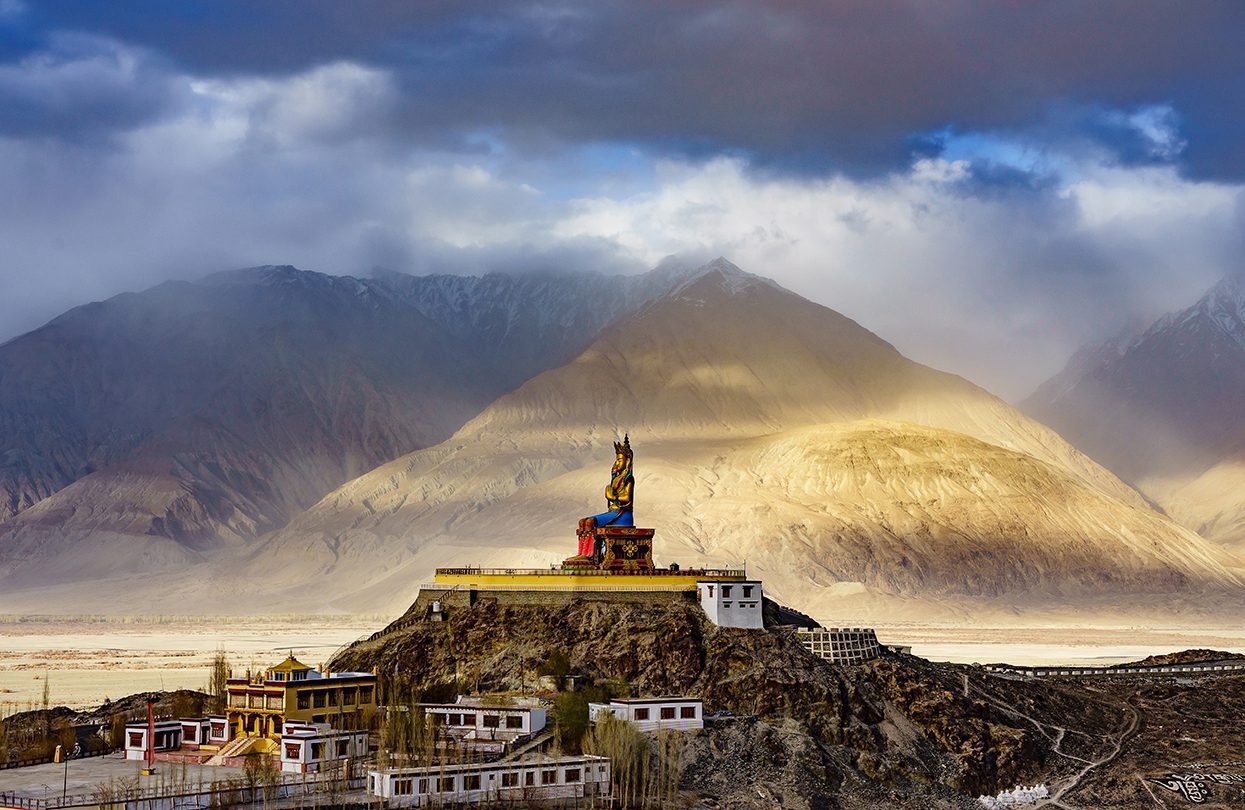
The Maitreya Buddha statue with Himalaya mountains in the background from Diskit Monastery or Diskit Gompa, Nubra valley, Leh (image by NavinTar).jpg
You sit in one of them and say nothing. The butter lamp burns. A monk turns a page.
At World Travel Magazine we have learned to tell two things apart. Some places hand you experiences. You collect them, photograph them, move on.
Ladakh does something else. It gives you space. Thin, high, silent space. Room enough to finally hear yourself think.
You carry it down with you. Off the mountain, onto the plane, into the noise.
The chant fades behind you, the light stays enormous, and the silence comes down the mountain in your chest. ◼
Subscribe to the latest edition now by clicking here.
© This article was first published online in Aug 2026 – World Travel Magazine.