
|
Listen To Article
|
There is a word in Zapotec that Oaxaca has spent five hundred years refusing to let die. Guelaguetza. It does not mean “festival,” though that is what the guidebooks will tell you. It means something closer to an economy of the heart: the obligation to give, and the certainty of being given to in return. When a family in a village outside Oaxaca marries off a daughter, the neighbours arrive with turkeys, with cacao, with sacks of maize — and every gift is written down, because one day the debt will be repaid at another wedding, another funeral, another roof that needs raising. To live inside a guelaguetza is to be permanently, gladly in one another’s debt. The festival that now carries the name is simply that idea made loud enough for a whole state to hear.
I learned this properly from Reyna, who sells tejate under the arches of the zócalo and has watched the crowds swell every July of her working life. Tejate is itself a lesson — maize, cacao, toasted mamey seed and the flower rosita de cacao, ground and beaten by hand until a pale foam rises to the top like something the drink is offering you rather than the other way round. “People come for the dancing,” she said, tapping the foam. “But the dancing is only the manners. The meaning is underneath.” She meant it as a description of the tejate. It works for the whole month.

Tejate drink from Oaxaca, Image by The Photo Pot, Shutterstock
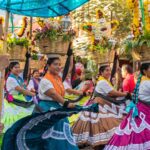
Here is what happens above ground. On the last two Mondays of July — this year the 20th and the 27th, the days everyone calls Lunes del Cerro, the Mondays of the Hill — delegations climb the Cerro del Fortín, the ridge above the city whose name translates, more or less, as the hill of the beautiful view. From the eight regions of Oaxaca they come: the Valles Centrales, the Sierra, the Costa, the Cañada, the Papaloapan, the Mixteca, the Tuxtepec lowlands, the Istmo whose women arrive in gold and geometry and out-dazzle the sun. Sixteen indigenous peoples, more or less, take the vast open-air auditorium in turn. The Flor de Piña dancers of the Papaloapan carry pineapples on their shoulders like offerings. The men of the Sierra Juárez stamp out rhythms older than the language you are reading this in. And then — this is the part that matters — at the close of each dance, the performers reach into their baskets and throw their gifts into the crowd. Pineapples, bread, hats, coffee, tiny bottles of mezcal, sombreros sailing over ten thousand heads. The auditorium becomes, for a few seconds, a single organism practising the thing the word means.
It would be easy to call this spectacle and leave. It would also be wrong. The Guelaguetza on the Cerro is a relatively young stage for a very old rite. Long before the Spanish, the Zapotec and Mixteca gathered on high ground to honour the powers of the maize harvest — the goddess the Nahua called Centéotl, whose name survives now in the Diosa Centéotl, chosen each July not for beauty in the pageant sense but for her command of her community’s customs, her language, her cooking, her memory. The corn ceremony absorbed a Catholic feast, absorbed a colonial city’s need to organise it, absorbed a tourist economy that could easily have hollowed it out, and somehow came through all of it still meaning what it meant on the hill three thousand years ago: that a good harvest is not something you hoard. Most cultures measure wealth by what a person manages to keep. This one, stubbornly, measures it by what they can bring themselves to throw away.
You could build an entire education out of eating your way through the argument. Oaxaca is, by common agreement among people who take the subject seriously, one of the two or three great food cities of the Americas, and July is when it shows its whole hand. The seven moles — the brick-red coloradito, the near-black mole negro that can take a day and thirty ingredients — are less recipes than genealogies. In the Mercado 20 de Noviembre you choose raw tasajo and hand it across for grilling in a corridor of smoke. The tlayuda, that vast crackling disc folded over beans and stringy quesillo, is street food in the way a cathedral is a building. And running straight through the same fortnight, from the 17th to the 28th, the Feria Internacional del Mezcal gathers a hundred producers of the smoked agave spirit that Oaxaca gave the world — a drink that is itself a guelaguetza, since the maestro mezcalero who plants an agave today is making a gift to whoever harvests it eight years from now, most likely his children.

Cecina tasajo and spicy meat is grilled mexican barbecue from Oaxaca Mexico, Image by Marcos Castillo, Shutterstock
Stay somewhere that understands all this rather than merely overlooking it. Casa Oaxaca, a few restored colonial rooms near Santo Domingo, keeps a rooftop and a kitchen that argue for the region’s cooking as seriously as anyone; Escondido Oaxaca hides contemporary calm behind an old façade; the Grand Fiesta Americana anchors the newer luxury end without pretending it invented the city. July is the rainy season, which the anxious traveller should hear as good news: the showers arrive briefly in the afternoons and leave the valleys an improbable green, and the crowds thin for exactly as long as it takes the sky to clear.
The truest thing I can tell you, and the reason World Travel Magazine keeps sending people to places rather than to postcards, is this: the best festivals on earth are not performances you watch. They are philosophies you are briefly, generously invited to stand inside. And the whole of Oaxaca’s fits into a single gesture. A dancer at the lip of the stage, sweat on her collarbone, reaches into her basket, finds your eyes in a crowd of thousands, and throws — and a stranger beside you lifts both hands into the wet July air and catches it. ◼
Subscribe to the latest edition now by clicking here.
© This article was first published online in July 2026 – World Travel Magazine.