|
Listen To Article
|
The most interesting argument in luxury hospitality right now isn’t about amenity or access. It’s about atmosphere as architecture — the idea that a room’s highest function isn’t shelter or status but the production of a specific emotional state. Three suites that reward a summer visit make this argument with unusual clarity. Each uses radically different materials. Each solves a different problem. And each understands something that the previous generation of luxury hotels mostly didn’t: that the body knows before the mind does whether a space was built with intention.
Water as Material: Patina Maldives, Fari Islands — The One-Bedroom Water Pool Villa
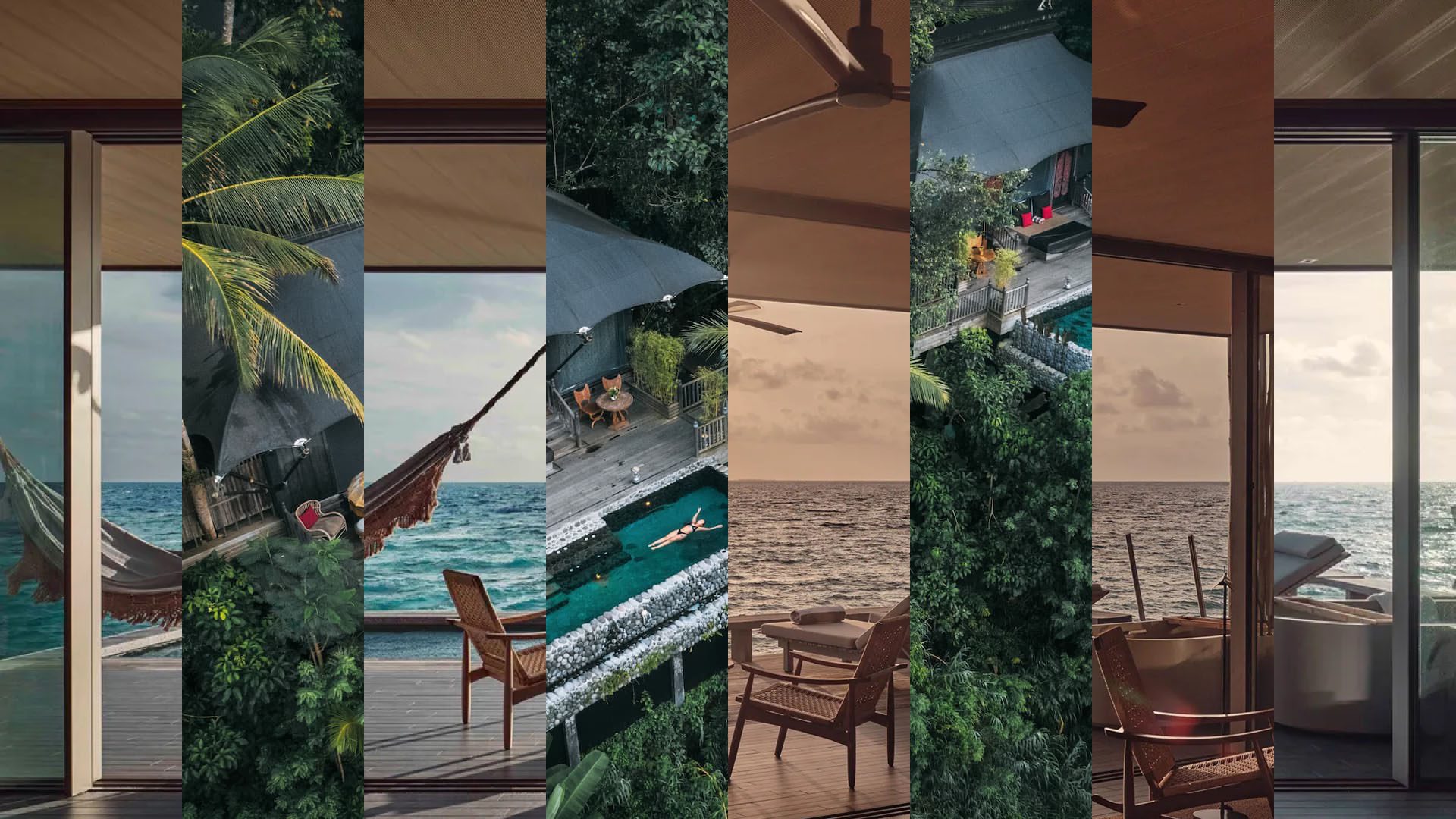
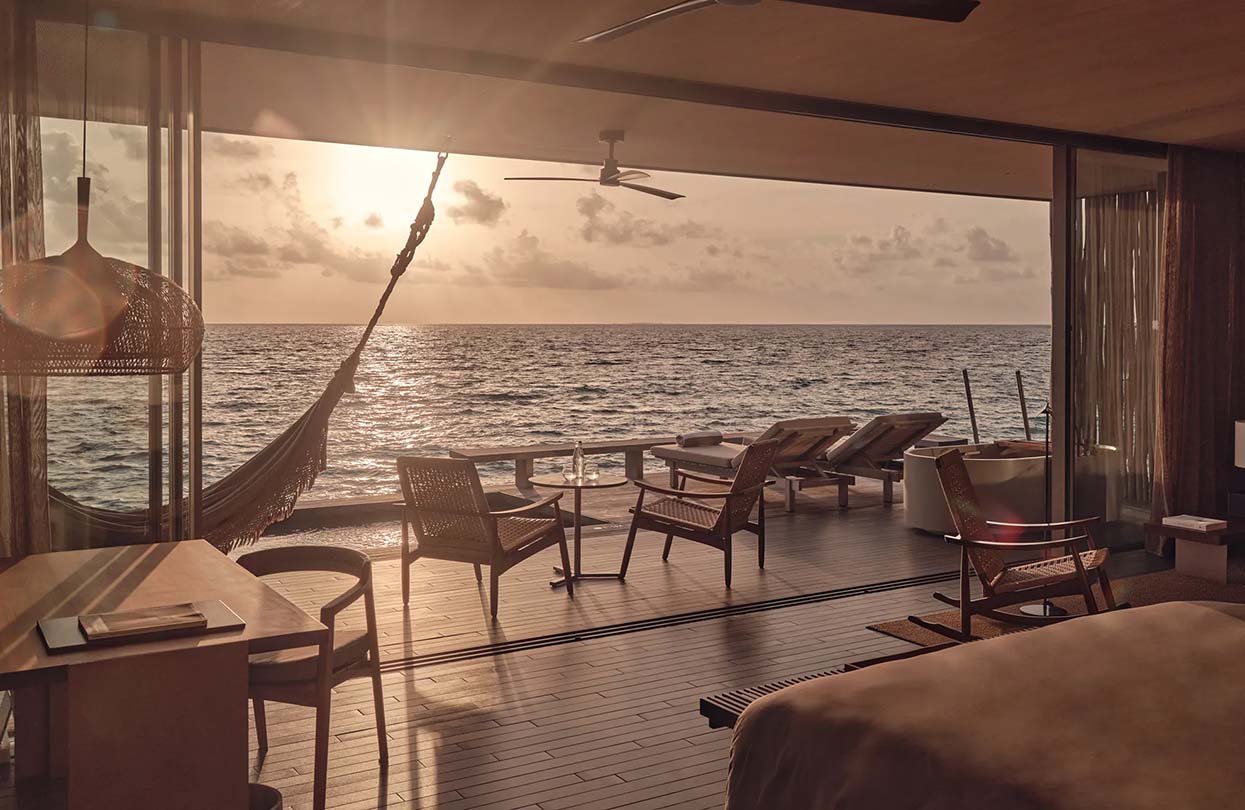
Most overwater villas in the Maldives treat the ocean as a view. The One-Bedroom Water Pool Villa at Patina Maldives, designed by Marcio Kogan and Renata Furlanetto of Studio MK27, treats it as a condition — something the architecture doesn’t frame so much as submit to.
The villa is 170 square metres of deliberate restraint. Floor-to-ceiling glazing on three sides slides fully open, so the room can move in seconds from enclosed shelter to open platform. This is the critical gesture: not a picture window that says look, but a wall that disappears and says you are already outside. The distinction matters. One is theatre. The other is Brazilian modernism’s oldest argument — that the boundary between interior and landscape should be negotiable, not fixed. Kogan spent five years developing the resort, and has spoken about arriving in the Maldives and sleeping in a hotel room that “could be in New York, or London, or Paris.” The Water Pool Villa is his correction: a room that could only be here.
Water as Material Patina Maldives, Fari Islands
The material palette reinforces this. Wood, rattan, stone, linen — earth tones in matt finishes that refuse to compete with the lagoon’s colour. Nero Marquina marble appears at the twin vanities, its dark veining a quiet counterpoint to the blonde warmth of everything else. Custom millwork by MK27, alongside pieces from Bassam Fellows, Gervasoni, and Vitra, sits low and horizontal, pulling your sightline toward the water. Nothing in the room rises to announce itself. Even the architecture across the island never breaks the tree canopy — a principle Kogan describes as ensuring “nature speaks louder than the architect.”
Summer is technically monsoon season in the Maldives, and this is where the architecture earns its keep. When afternoon rain arrives — sudden, heavy, warm — and the glass slides shut, the villa becomes something else entirely: a vessel. The lagoon darkens, the sound closes in, and the room that dissolved into the ocean an hour ago now holds you above it. For the traveller, this is a familiar monsoon pleasure — the deep comfort of shelter during rain, not merely after it — given architectural form. Patina offers not a room with a view but a room whose relationship with water changes by the hour.
The Museum Problem: Rajmahal Palace RAAS, Jaipur — The Maharaja’s Apartment
Every heritage hotel must answer a question that has no clean solution: how do you sleep in a museum?
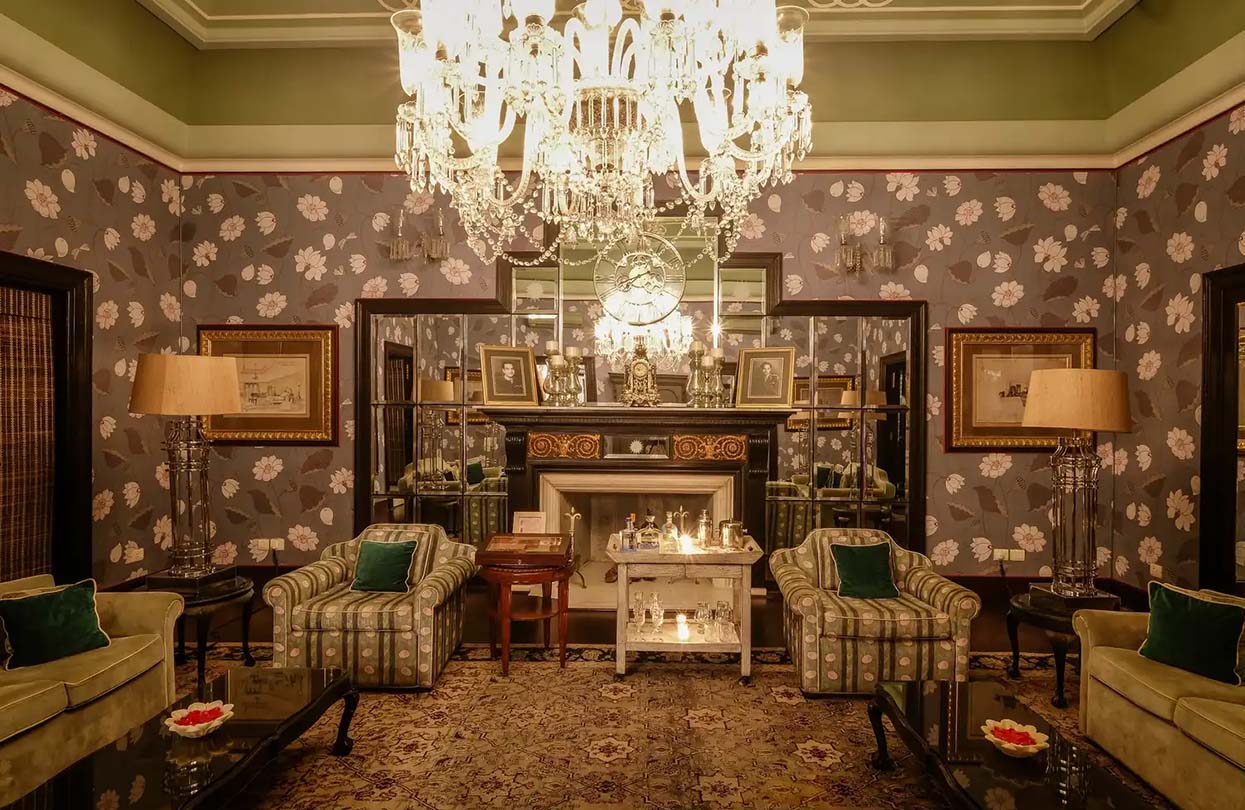
The Maharaja’s Apartment at Rajmahal Palace RAAS — formerly Sujan Rajmahal Palace — offers one of the more persuasive answers. The palace dates to 1729, was remodelled in Art Deco style during the 1930s under British residency, and later became the private home of Maharaja Sawai Man Singh II, the polo-playing prince whose guest list included Queen Elizabeth, Jackie Kennedy, and the Shah of Iran. The apartment — 3,236 square feet across a private entrance hall, living area, separate bar, drawing room, terrace, and an eight-person dining room hung with portraits of Jaipur’s maharajas — was the private quarters of two successive maharajas. The bones are ceremonial. The question is whether you can rest inside them.
What makes it work is Adil Ahmad’s interior design, which refuses both reverence and erasure. Ahmad created 46 custom wallpapers for the palace’s 13 rooms, each drawing from the stone carvings of Rajasthan’s forts and havelis but rendered in a palette so saturated — electric pinks, deep turquoises, burning oranges — that it reads as commentary rather than reproduction. The effect has been compared, not unfairly, to Wes Anderson. But the intelligence is more specific. Ahmad understood that symmetry is the grammar of palatial Indian architecture, and enforced it throughout — mirrored doors and false doors maintaining visual balance even where the 300-year-old structure doesn’t cooperate. The result is a space that feels composed rather than decorated.
The Museum Problem Rajmahal Palace RAAS, Jaipur
The apartment resolves the museum problem through spatial generosity. The marble bathroom is large enough to feel like a room you’d choose to inhabit, not pass through — and at three in the morning, when your bare feet meet that marble, the cold is a small shock that locates you physically in the building’s age. The drawing room opens to a private terrace where Jaipur’s evening light turns everything the colour of the city itself. In summer, when Rajasthan’s heat makes the outdoors adversarial by noon, this becomes the suite’s defining luxury: you live between the cool sealed interior and the terrace at dusk, the palace holding its temperature like the stone havelis of the old city always have.
It is worth noting what the architecture cannot solve. Several rooms in the palace lack exterior windows entirely, and while Ahmad’s mirror-work compensates visually, the absence of natural light is felt. For the Indian traveller accustomed to the interplay of shade and sunlight that animates haveli design, this can register as a sealed quality, the room holding you too closely. But the Maharaja’s Apartment, with its terrace and its scale, largely escapes this. The seven acres of walled gardens — fountain-threaded, impossibly quiet for central Jaipur — provide the decompression the interior rooms sometimes withhold.
Narrative as Architecture: Capella Ubud, Bali — The Keliki Tent
Capella Ubud is not, strictly speaking, a hotel. It is a fiction you sleep inside.
Bill Bensley’s design premise — a camp of shipwrecked Dutch settlers arriving in 1800s Bali — could easily have produced a theme park. Instead it produced one of the most architecturally principled properties in Southeast Asia, and the principle is this: minimal intervention. The site is nine acres of rainforest and rice paddy in Keliki Village, threaded by the sacred Wos River. The original brief called for 120 rooms. Bensley talked the owner down to 22 one-bedroom tents and a single two-bedroom lodge, then built them without cutting a single tree. Palm trunks rise through terraces and tent floors. Bamboo mockups were erected to position each tent for the best jungle sightline while preserving the canopy. The architecture was fitted to the forest rather than the other way around.
You reach each tent via snaking footpaths, steep stone steps, and hanging bridges — a circulation that forces slowness and makes arrival physical. The tents are floored in teak handmade in Central Java, entered through hand-carved Balinese doors that took craftsmen a year to produce. Each is themed around a character from the camp’s fictional history — the Cartographer, the Puppet Master, the Explorer — with interiors furnished from upcycled antiques Bensley sourced from secondhand shops in Kerobokan. Vintage trunks conceal minibars. Brass telescopes sit alongside ikat textiles and wayang puppets. It is maximalist in the extreme.
The honest assessment: Bensley’s colonial-camp theatrics — the narrative of European settlement told as whimsy — sit uncomfortably if you think about them for longer than a moment. The design is entertaining, but it skirts a line between homage and costume that not every guest will read the same way.

Narrative as Architecture Capella Ubud, Bali
What saves the project is the relationship between tent and jungle. The freestanding copper bathtub on the outdoor deck places bathing directly in the sightline of the rainforest canopy — copper chosen because it holds heat evenly and develops a living patina in Bali’s humidity, its surface changing week by week. Summer’s wet season makes the tent experience more intense: rain on canvas is loud, intimate, enveloping, and the jungle responds — greener, louder, closer. A sacred Balinese temple, predating the hotel entirely, sits at the property’s lowest point on its own holy water source, a reminder that the land’s spiritual architecture was here long before Bensley’s fictional one. For discerning traveller, the outdoor bathing, the jungle proximity, the private pool — this is a spatial grammar of water, shade, and enclosure that region’s resort architecture understands instinctively. What Capella adds is the narrative layer: the sense that every object has a reason beyond decoration, even if that reason is a story.
What connects these three rooms — a platform over water, a palace made intimate, a jungle entered by degrees — is a shared conviction that luxury is not a quality of surfaces but a quality of attention. Each asks its architect’s real question not of the eye but of the nervous system: Do you feel different here? The answer, in all three cases, is yes — and that is what the best rooms have always understood: not spaces you photograph, but spaces that, for a night or a week, change the way you move through every room that follows. ◼
Subscribe to the latest edition now by clicking here.
© This article was first published online in May 2026 – World Travel Magazine.