|
Listen To Article
|
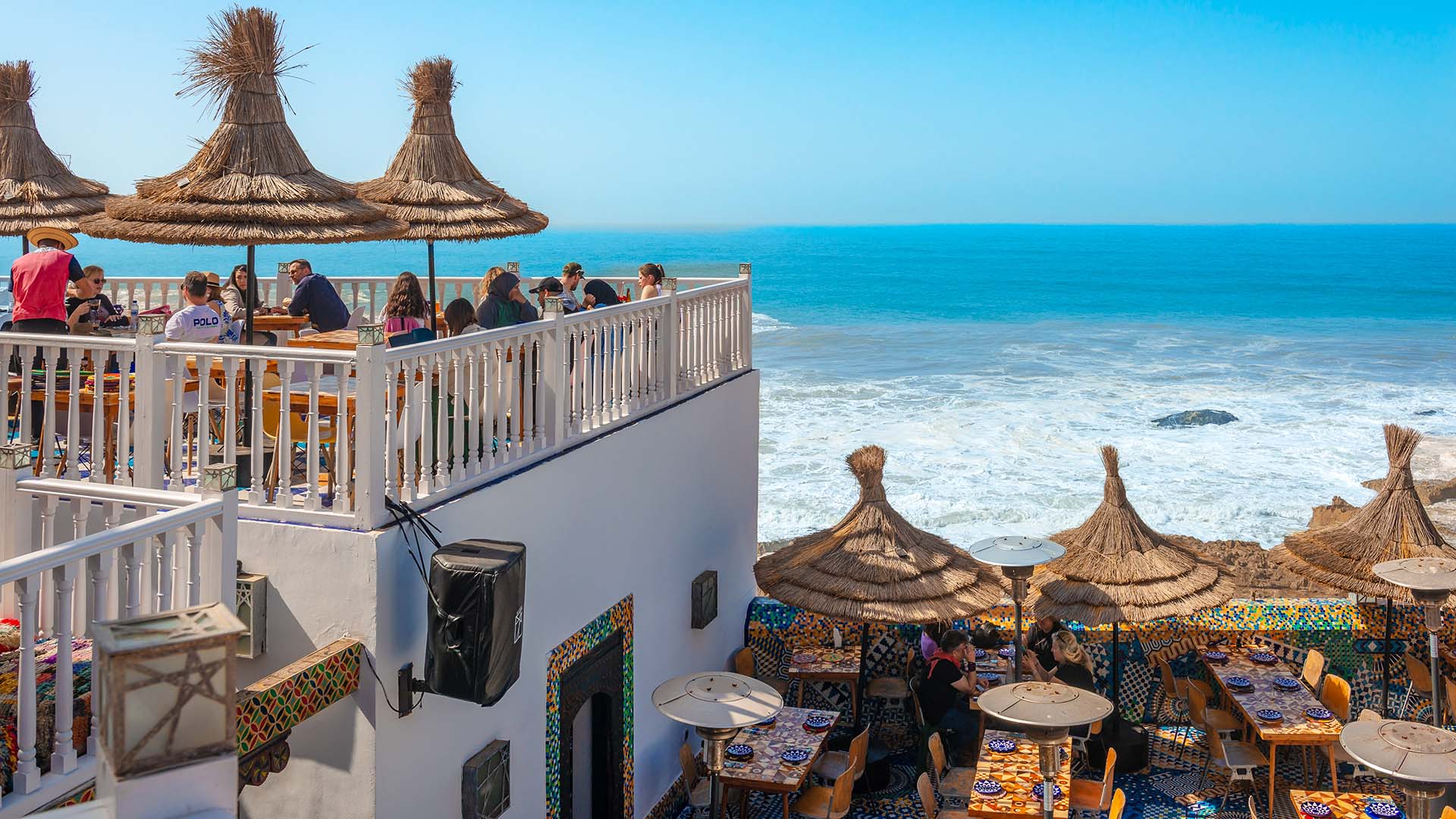
In Essaouira, you hear the wind before you see the sea: the Atlantic coming off the water in one long, unbroken breath that never quite stops. You feel it on the last curve of the road from the interior, a hand laid flat against the car window, and then you step out into it and it moves through your hair, your collar, the loose weave of your shirt, and something in your shoulders that has been clenched since the airport quietly lets go. The Moroccans call it the alizés, the trade wind, the Atlantic breathing in from the west across a sea that has never once been warm. The Portuguese sailors trusted it. The fishermen still do. It has its own weather, its own hours, and by the second day you find that you have started listening for it the way you listen for a voice in the next room.
This is the secret the calendar keeps. In July, while Marrakech lies four hours inland under a heat that presses the breath out of the afternoon, and Fes shimmers and stills and waits for dusk, the coast here holds at a temperature the body forgives. The wind does the cooling. It arrives salted and steady off the water, combs the dune grass, fills the sails out in the bay where the windsurfers lean their bodies into it like people leaning into an argument they enjoy. You do not sweat in Essaouira. You are rinsed.
The medina is white, and then it is blue, and the blue is not one blue. It is the faded cornflower of a shutter that has weathered thirty summers, the deep cobalt of a freshly painted door, the grey-blue of fishing nets drying against a wall the colour of bone. The light here is famous among people who chase light for a living. Orson Welles came to these ramparts to film Othello because the sun off the Atlantic did something to stone and shadow that no studio could counterfeit, and you understand him within an hour of arriving, when the whitewash goes gold and the blue goes violet and the whole town seems lit from a source slightly to the left of the real one.
View this post on Instagram
Walk to the ramparts in the late afternoon. The old Portuguese cannons still point out to sea, green with salt, and below them the waves come in long and unhurried and break against the rocks with a sound like the town exhaling. Gulls hang almost motionless in the updraft, wings set, going nowhere, and you envy them. Out past the wall the Îles Purpuraires sit low and blue on the horizon, and the wind carries the call to prayer up and over the roofs and thins it and folds it into the sound of the sea until you cannot say where one ends.
Down at the port the boats are the same blue as the doors, dozens of them, rocking at their moorings, and the men mend nets with their fingers moving faster than their conversation. The day’s catch comes ashore silver and slapping, and someone grills sardines over coals right there on the quay, and the smoke of them mixes with the diesel and the salt and the sharp green smell of argan oil from a stall nearby, and this is the true perfume of the place, older and better than anything bottled. You eat the sardines standing up, with your fingers, the flesh hot and smoky and tasting faintly of the sea it left an hour ago, and it is the kind of meal you will describe to people for years without ever quite conveying it.
And underneath everything, the music. Essaouira is the spiritual home of gnaoua, the trance music the descendants of enslaved West Africans carried here and kept, the deep buzz of the guembri and the iron clatter of the qraqeb building and building until the rhythm stops being something you hear and becomes something that is happening to you. In the alleys a musician plays for no one in particular. This is a town of makers. In the thuya-wood workshops the craftsmen bend over the fragrant burl, inlaying lemonwood and mother-of-pearl, and the whole street smells of cut cedar and patience. Painters work behind open doors. Nobody hurries you. Nobody hurries at all.
Stay inside the walls, at the Heure Bleue Palais, the Relais & Châteaux riad whose courtyard holds the wind out and the birdsong in, where the rooftop pool sits under an open sky and the town’s noise arrives softened, a rumour of itself. Or take a villa above the beach where the shutters knock all night and you sleep better than you have in months. Either way it is the wind that puts you under, and the wind that wakes you.
View this post on Instagram
This is what World Travel Magazine means when it says that some places you go to for what you see and others for what you feel on your skin. Essaouira resets something. The constant sea, the light that will not sit still, the drums, the unbroken breeze that asks nothing of you: by the third morning your pulse has slowed to the town’s, and the part of you that was always calculating the next thing has simply stopped, mid-sentence, and forgotten what it was going to say.
You will leave. Everyone does. But weeks later, in a still and airless room in another city, you will feel a door move on its hinge, or catch the iron shiver of a rhythm you cannot place, and there it will be again, on your skin, in the sails, in the music: the wind that had a name, calling you back to the water. ◼
Subscribe to the latest edition now by clicking here.
© This article was first published online in July 2026 – World Travel Magazine.