
|
Listen To Article
|
Bali is not overcrowded. It is unevenly explored. Hold that thought while you scroll this week, because half the people you follow are standing in the same three square kilometres of the island’s south, ordering the same negroni at the same beach club, waiting for the same sunset. And it is a wonderful sunset. Seminyak earns its reputation. Canggu is genuinely fun. The Uluwatu cliffs do something to your chest that no photograph has managed to hold.
Go anyway. Just not there.
Point the car east. Give it an hour.
The Sidemen Valley sits in the shadow of Mount Agung, the volcano the Balinese treat as the axis of the world — the direction they sleep toward, orient temples toward, carry the dead toward. The rice terraces run in green steps up toward the cone, and in early light they hold water like a staircase of mirrors, fed by a thousand-year-old irrigation cooperative called the subak. This is what Ubud looked like before Ubud became a verb. The weaving here is still weaving — songket cloth made on backstrap looms by women who learned from women. The farming is still farming. Nobody is performing the village for you.
They are just living in it, and letting you watch.
Where you sleep matters, and here it is quiet luxury without the queue. Wapa di Ume Sidemen puts a plunge pool at the lip of the valley and lets the terraces do the rest — you wake to the sound of water moving through the paddies below. Higher up the road, Samanvaya sets an infinity pool that reads, from the right lounger, as though it spills straight into the rice. Neither will make you share the view. That is the entire proposition.
And your timing, if you move now, is exact.
Because through 11 July, forty minutes down the hill in Denpasar, the Bali Arts Festival is on — Pesta Kesenian Bali, the 48th edition, running since 13 June at the Taman Werdhi Budaya arts centre on Jalan Nusa Indah. This is not a spectacle arranged for visitors. This is Balinese communities from all nine regencies presenting gamelan and sacred dance as devotion — as an offering, which is precisely what the word persembahan means. Legong. Baris. The shadow puppets of wayang kulit that begin after nine and run past midnight. The food bazaar near the gates does babi guling and ayam betutu the way the tourist restaurants have forgotten how.
Entry is free. Photography without flash. Silence your phone, applaud at the end and not during, and sit among far more locals than foreigners.
You will understand something about this island that no beach club has ever tried to teach you.
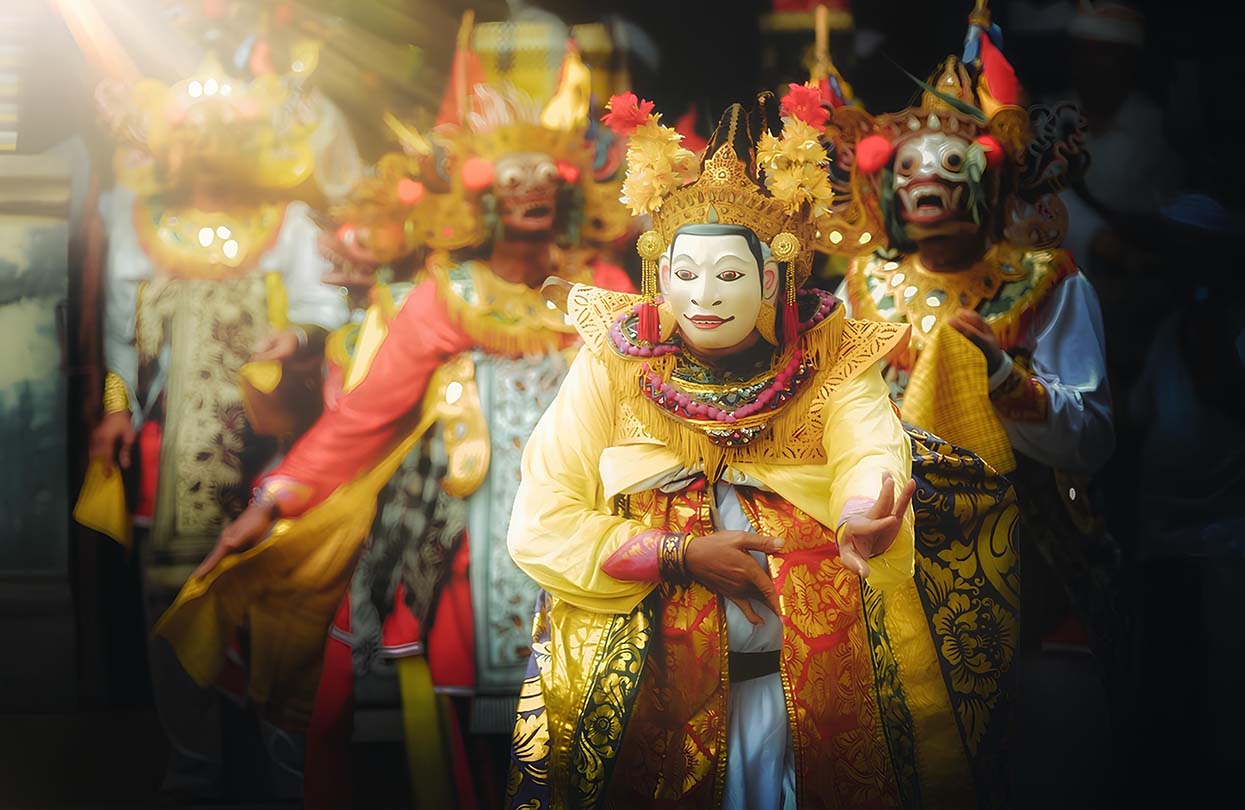
Traditional Balinese Wayang Wong, Image by KanaVisual, Shutterstock
Sidemen is a base, not the whole case. East Bali is the island’s quiet half.
Drive north to Tirta Gangga, the old royal water palace where you cross carp ponds on stepping-stones fed by mountain springs. Keep going to Amed, where the diving is black volcanic sand and a wartime shipwreck at Tulamben you reach by walking in from the beach. Wake before dawn and watch Mount Agung take the first light while the coast is still asleep. This is the Bali that the guidebooks of twenty years ago were describing — and it never left. Everyone else simply stopped turning off the main road.
Now, the honest part.
I am aware of the paradox. Telling everyone to go to Sidemen is exactly how Sidemen eventually becomes Seminyak. So here is the arrangement. Go. Stay a few nights. Tip generously, buy the cloth directly from the woman who wove it, learn to say suksma. And when you post the photograph of that impossible green staircase at dawn — and you will — do the valley one small kindness.
Don’t tag the location.
The World Travel Magazine view is simple, and it has nothing to do with escaping people. Bali does not have a crowd problem. It has a distribution problem. The south is loved to saturation while an hour east an entire other island sits, greener and slower and, for now, very nearly yours.
The famous Bali will still be there next July, busier than ever, and still wonderful. That is the good news and the trap in one sentence.
The Bali an hour east is having its best season this exact moment — the terraces flooded, the volcano clear, the arts festival running its final days.
It is not hiding.
It is just waiting for you to turn off the main road. ◼
Subscribe to the latest edition now by clicking here.
© This article was first published online in July 2026 – World Travel Magazine.