
|
Listen To Article
|
The first thing is the light, and it arrives the way good news arrives, slowly and then all at once. By late afternoon on Salina, a small volcanic island off the north coast of Sicily, the sun has stopped beating down and begun instead to lean, long and low and the colour of pressed apricots, sliding across the whitewashed houses of Malfa until their walls turn the particular gold that photographers fly across continents to chase and almost never hold, because what undoes you about this light is its patience, the way it takes its time crossing a terrace, the way it lingers on a wall as though it too has nowhere else to be. The sea below the village deepens by the minute. First a hard blue, then something softer, then violet at the edges where the water meets the black volcanic rock.
You feel it before you understand it.
This is the greenest of the Aeolian Islands, the volcanic cluster that floats in the sea north of Sicily, the one where the hills keep their colour into summer, where capers grow wild out of the stone walls and fennel comes up along every path, and in June the whole island smells of all of it at once: salt first, always salt, then the green pepper sharpness of the caper bushes, and somewhere below, the slow blue thread of wood-smoke from someone grilling fish on a terrace not yet visible, the smell of it arriving before the sound, before the clink of the first glass set down on stone. A Vespa climbs a road somewhere out of sight. The sea works against the rock with a sound that limestone coasts never make, lower, rounder, a kind of breathing.
I had come to this corner of southern Italy on assignment for World Travel Magazine, which is to say I had come to pay attention.
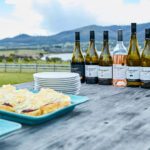
By the time I reached the terrace at Capofaro, where the vines run almost to the cliff edge and Malvasia has grown in this soil longer than anyone living can remember, the day had begun its long surrender. There is a wine they make across these Sicilian islands from grapes left to dry in the sun until their sweetness concentrates, Malvasia delle Lipari, the colour of held honey, and the first sip of it, cold against the warm evening, does something to the shoulders before it does anything to the tongue. They come down. You had not known they were up.
View this post on Instagram
Across the water, Stromboli.
It sits on the horizon the way a sleeping animal sits in a room, enormous and entirely calm, and every so often, without urgency, it exhales, a soft grey plume that rises and bends and dissolves into a sky going pink behind it. There is no drama in it. Only the oldest possible reminder that the earth is alive and in no particular hurry, that it has breathed like this for thousands of years and will go on long after the glasses are cleared. You watch it the way you watch a fire. Time does something strange in the watching.
And this is the thing about these islands that no spa has ever managed to bottle, that no treatment promises and no city weekend delivers: the slowing is not something you do. It is something done to you. You do not decide to decelerate. The island is simply moving at a frequency lower than your own, and within an hour, two at most, your body has quietly matched it, the way a held note finds the pitch of the room. Your breath lengthens without your permission. Your hand stops reaching for the phone. The deceleration is involuntary, and that is exactly why it works, because the part of you that exhausts itself managing things was never invited to come.
Dinner, when it comes, comes slowly.

Malfa, Image by Robert Harding Video, Shutterstock
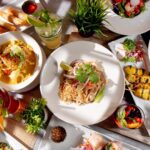
It is impossible to describe what is eaten here without missing the point, because the point is never the dish. The point is the warmth of bread torn by hand, the heat of the day still living inside a tomato that grew three fields away, the particular generosity of being fed by people in no hurry to turn the table, the long pauses between courses in which no one reaches for anything because there is, suddenly, nothing more urgent than the candle and the wine and the dark sea sound rising from below. You eat for hours. You are not aware of the hours.
And for anyone who carries some older country folded somewhere inside them, there is a recognition in all this, not nostalgia, nothing so heavy as that, but the warm and slightly startling sense of a slowness the body knew long before the mind learned to forget it. The evening meal that goes on and on. The grandmother’s certainty that no one should leave the table soon. It is not quite a memory. It is the body remembering that it once had one.
The walk back happens in the dark, and the dark here is warm.
The whitewashed walls have spent the whole day taking in the sun, and now, hours past sunset, they give it back, so that as you climb the narrow lane toward bed you let your hand trail along the stone and find it warm, still warm, warm the way skin is warm, holding the entire day inside it and letting it go slowly into the night. Your hand stays there a moment longer than it needs to. Below you, the sea keeps its rounded breathing against the rock.
And out across the dark water, Stromboli glows faintly, a low ember breathing its grey breath into a sky thick with stars. ◼
© This article was first published online in June 2026 – World Travel Magazine.