
|
Listen To Article
|
The man next to me had ordered something orange. I pointed at it. The chef — a man in his sixties with the hands of someone who had been slicing fish since before I was born — looked at me, then at the man, then at me again, and nodded once.
It was 5:47am at Toyosu’s outer market, in a sushi-ya with eight stools and a menu I could not read. I had been in Tokyo for four hours. I had slept for forty minutes. I was the only person in the room who was not Japanese.
The orange thing arrived in a small wooden box, sitting on rice, glistening. It was uni — sea urchin — but I did not know that then. I knew only that something cold and sweet and faintly oceanic dissolved on my tongue without effort, the way a memory does. The chef watched me. I made an involuntary sound. He smiled. The man beside me, without looking up from his own bowl, said quietly, “Hokkaido.”

Mekiki Yokocho in Toyosu Senkyaku Banrai, Image by Jye Shen, Shutterstock
I have no idea what else I ate that morning. I pointed three more times. Three more things arrived. I paid in cash, bowed in the general direction of the kitchen, and walked out into a Tokyo morning the colour of a clean knife.
I had brought a list, of course. A man my age does not fly twelve hours without one. Shibuya crossing at sunset. Tsukiji (which has moved, which I did not know). A ramen place a friend’s chef-cousin had insisted on. A World Travel Magazine feature I had torn out and folded into my passport. I lost the list somewhere on the second day — possibly on a train, possibly in a Family Mart. What happened afterwards is the only reason for this piece.
The wrong train was to Shimokitazawa. I had meant to go to Shibuya. I ended up in a neighbourhood that smelled faintly of incense and frying onions and old books, with vintage shops the size of a Mumbai bathroom, run by men who looked at my Uniqlo shirt with the disappointed gaze of priests assessing a poorly chosen offering. I bought a Charles Mingus record I cannot play because I no longer own a turntable. And then I found the kissaten — a coffee place that is also a jazz bar, with speakers the size of a small refrigerator and a man in his seventies behind the counter wearing the most beautiful horn-rimmed glasses I have ever seen.
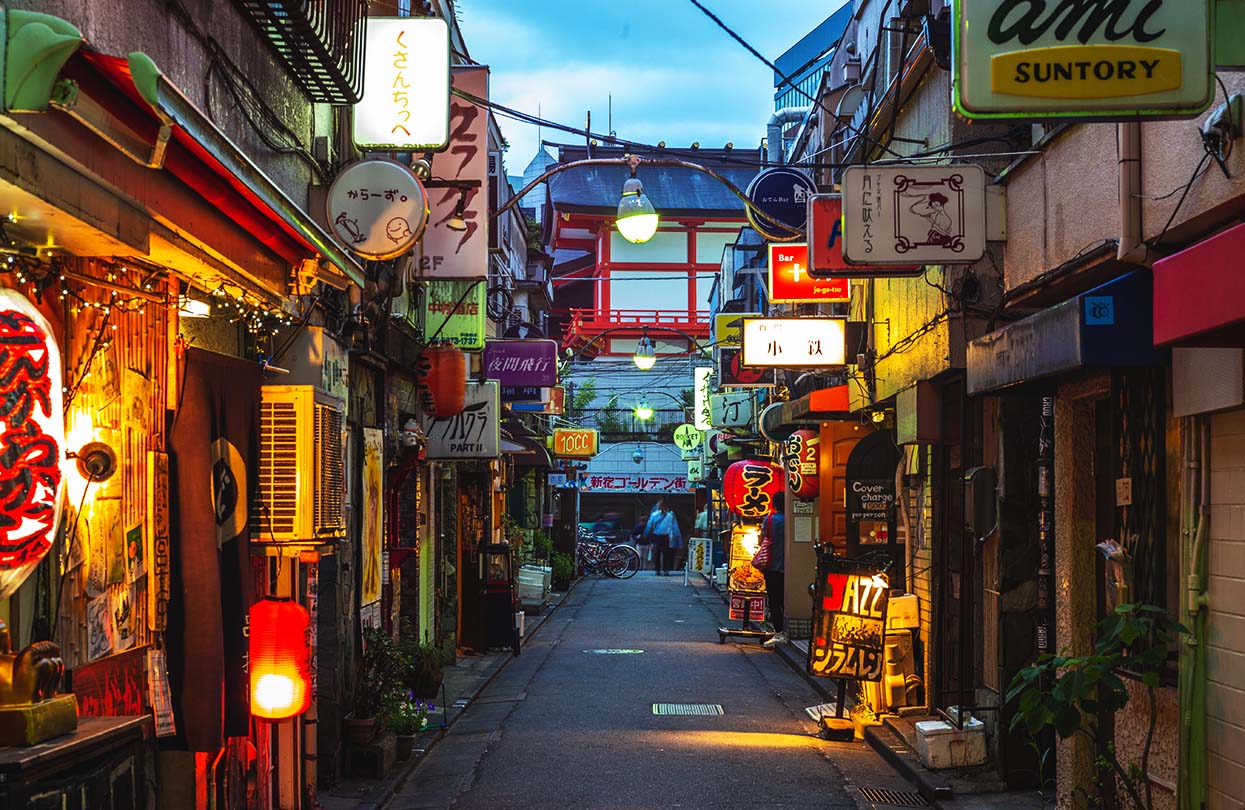
There are over 200 tiny shanty-style bars, clubs and eateries at Shinjuku Golden Gai, Image by Richie Chan, Shutterstock
He put on Coltrane. A Love Supreme. I sat there for fifty-six minutes. I had not been still that long in eighteen months.
The depachika that afternoon — the basement food hall of Isetan in Shinjuku — undid me in a different way. I went down for a snack. I stayed ninety minutes. Japanese grandmothers were choosing wagashi (small sweets, sometimes shaped like leaves) with the gravity of a Mughal emperor selecting jewels. One of them held a single sweet at eye level, turned it, frowned, and put it back. She picked another. She did this seven times. I thought of my mother at Ghasitaram’s, the same furrowed concentration, the same refusal to be hurried, and I understood for the first time that there are forms of love that look identical across continents — they just happen to use different sugar.
Golden Gai is six narrow streets of bars the size of a Mumbai elevator. I walked into the second one I tried because there was a hand-painted saxophone in the window. There were four stools. Three were taken. I sat in the fourth.
The man next to me had been, in a previous life, a salaryman at a steel company. He was now, he explained through a phone that translated his Japanese into approximate English with the cheerful incompetence of a hotel concierge, a jazz drummer. He played on Sundays in Kichijoji. He asked what I did. I said I worked in advertising. He typed back: “That is also a kind of percussion.” Then he laughed — a real one, from the belly — and I laughed, and the bartender, who had been wiping the same glass for ten minutes, allowed himself the small smile of a man who had watched this exact conversation happen, in slightly different forms, four thousand times.

Traditional street bars in Shinjuku Golden Gai district at night, Image by HknKirmizi, Shutterstock
Day two opened at a small shrine fifteen minutes from my hotel. I went because I could not sleep. There was nobody there at seven. The torii gate was vermilion against a sky still grey. A vending machine beside it sold cold green tea for one hundred and thirty yen. I stood with the can and listened to nothing, and realised, slowly, that the loudness of Tokyo is a surface — that underneath, the city operates on a frequency of precision and silence that someone who comes from a country of maximum noise finds, unexpectedly, like being held.
The konbini at 2am is where it landed. I had bought an onigiri — tuna mayonnaise, because I am, finally, predictable. The wrapping was a small engineering miracle: a plastic sleeve that kept the dry nori separate from the wet rice until you pulled a tab, at which point they met, perfect and crisp, in your hand. I stood under the fluorescent light at a Lawson on a side street in Nishi-Azabu and thought: this is what it looks like when you care about something so much that the care disappears.
The Shinkansen the next morning was punctual to the second. Tokyo flattened, then thinned, then was gone. I thought about the chef at Toyosu, who had served me four things I could not name, and the man beside me who had said “Hokkaido,” and the fact that I had eaten them anyway. Translation, I realised, is not the words. It is the willingness to point at what someone else is having and trust that whatever arrives, you will know what to do with it. ◼
Subscribe to the latest edition now by clicking here.
© This article was first published online in June 2026 – World Travel Magazine.