
|
Listen To Article
|
The Leopard Hour. Everyone who loves this island keeps the same private conviction: the great thing about Sri Lanka was never the tea or the surf the east coast is finally famous for. It’s the cats.
Consider the arithmetic, because it’s absurd. Sri Lanka holds the highest density of leopards anywhere on earth. And the animal itself is its own creature, Panthera pardus kotiya, the Sri Lankan subspecies, bigger and bolder than its cousins for one reason: it has never had to share. No lion, no tiger, nothing above it on the whole island. When a predator sits alone at the top, it stops slinking. It walks the open track at dusk the way it owns the road, which it does.
That is the hour the whole trip is built around. The heat cracks a little after five, the dust turns gold, and the leopard comes down to the sand tracks to patrol before dark. There is genuinely nowhere else on the planet where the odds of that sight are so high. So the only real questions are where you stand when it happens, and who is sitting beside you reading the alarm calls.
The parks. Yala is the headline, and deservedly, with the density that makes the reputation and a Block 1 landscape of rock and lagoon that photographs like nowhere else. It is also the one everyone has heard about, which means the trick is not whether to go but how. The intelligence here is simple and unglamorous: be first through the gate at dawn, run the far loops the day-trippers skip, and carry your own tracker so you’re not idling in a scrum at the one sighting the radio just announced. Done right, Yala at first light feels private. Done wrong, it feels like a car park with elephants.
Wilpattu is the connoisseur’s answer, and quietly the one the families who book nothing without their advisor’s blessing have been moving to. It’s the largest park on the island, older, wilder, threaded with the villus, the natural lakes that give it the name the land of lakes. Fewer vehicles, longer silences, leopards that feel genuinely found rather than queued for. If you have the days, split them: Yala for the drama and the density, Wilpattu for the hours when it’s only your vehicle and a peacock screaming that a cat is moving. And for the obsessives, Kumana in the southeast, a wetland that turns into one of Asia’s great bird theatres in season, painted storks and pelicans stacked over the lagoon while everyone else is chasing spots.
The camps. Three properties define the high end, and they are not interchangeable. Wild Coast Tented Lodge, the Resplendent Ceylon property on the very edge of Yala, is one of the great safari addresses on earth full stop: bamboo-ribbed cocoons that look like something a very rich pangolin might commission, dropped where the jungle meets the Indian Ocean, so you fall asleep to surf and wake to the gate a few minutes away. Ask about the pool tents on the ocean side; the sound at night is the point.
View this post on Instagram
Leopard Trails is the specialist’s choice, mobile luxury tents run by the people widely held to field the best trackers in the country. This is where you go when the sighting matters more than the thread count, though the tents want for nothing. Their naturalists are the difference between a good drive and the drive you describe for years. And Chena Huts by Uga is the one for the traveller who refuses to choose, thatched cocoons on the Yala coast where the bush effectively runs into the beach, each with its own plunge pool, elephants some mornings on the sand.
The experience. What no one tells you until you’re there is that the leopard is only the marquee name. Sri Lanka runs a trifecta almost nowhere else offers in one modest island: the leopard at dusk, elephants in real herds, and the sloth bear, the shaggy, comic, genuinely rare prize that even seasoned Africa hands come here specifically to tick. A good private naturalist stitches all three together across a dawn and a dusk drive, reading the langur alarm calls and the spotted-deer barks like a second language while you sit back and watch the forest tell on itself.
The access intelligence. Timing first, since it’s where people get it wrong. You are reading this in the good window: the dry-zone parks are open and rewarding through July and August, and Yala’s main block doesn’t take its long closure until roughly September into mid-October, when the drought bites and the park rests. So the shoulder is now, and it rewards you with thinner crowds and animals concentrated at the shrinking water. Book the camps far ahead, further than you think, because there are very few of these tents and the people who know fill them a season out. The single upgrade that changes everything is the private vehicle and dedicated tracker; take it without hesitation, because sharing a jeep means sharing someone else’s agenda at the exact moment the light goes gold. And build the island the way it’s meant to be built: three or four nights in the parks, then fold in a beach stretch down the coast or a few days up in the cool green of the hills, culture and sand and wilderness inside a drive of each other. That combination, safari and beach and temple in one small country, is the thing Africa cannot do, and the reason the World Travel Magazine view is unequivocal: for anyone who still thinks safari means only one continent, this is the correction.
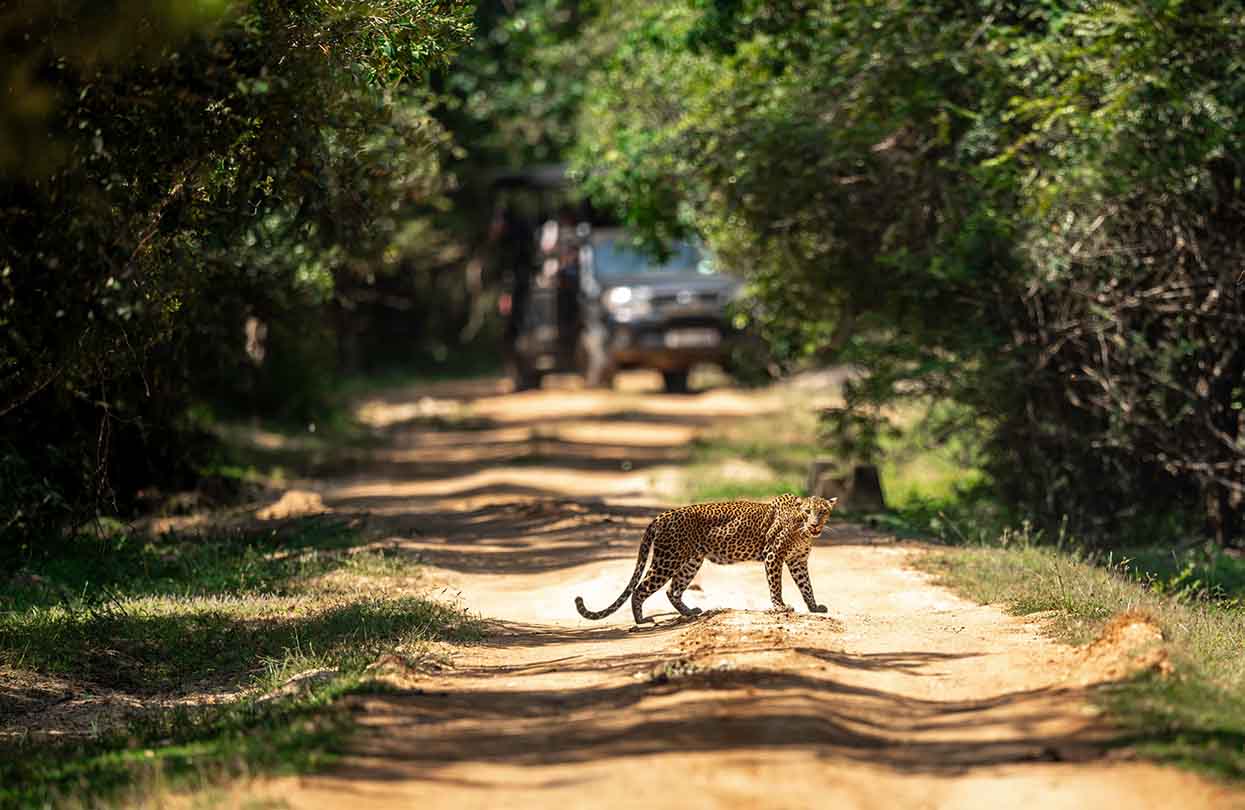
Sri Lankan leopard at Yala National Park, Image by Dimuthu Jayawardane, Shutterstock
Which brings us back to the hour. It is nearly six, the tracker’s hand goes up, flat, and the engine dies to nothing. A deer barks once, somewhere left. Then the grass at the edge of the track parts, unhurried, and the gold shoulder of a leopard steps out onto the sand, turns its head, and looks straight down the road it owns. ◼
Subscribe to the latest edition now by clicking here.
© This article was first published online in Aug 2026 – World Travel Magazine.